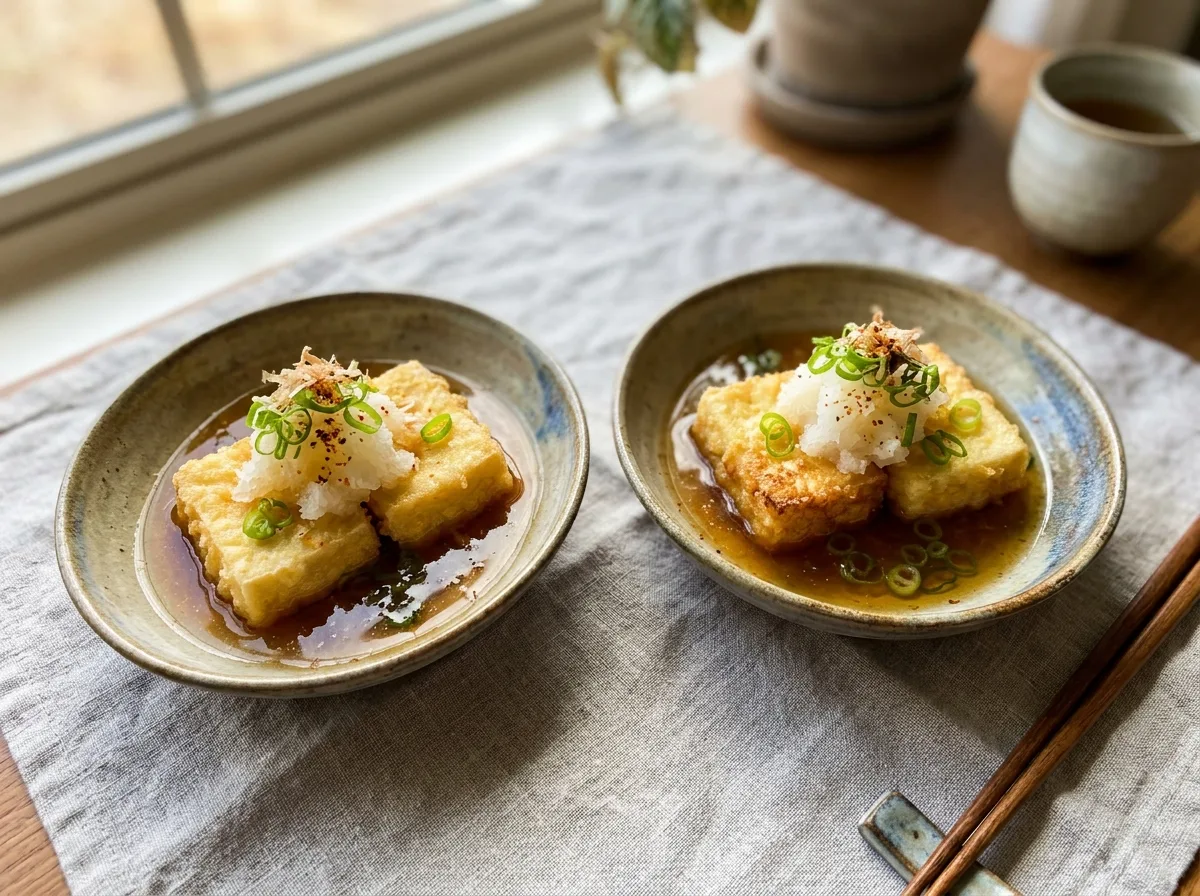
Agedashi-Style Crispy Tofu in Dashi Broth
Rate this recipe
~$3.80 CAD per serving (estimate)
Ingredients
- 600 gfirm tofu (pressed for 15 minutes)
- 1 litrecold water
- 15 gdried kombu (one or two pieces, wiped with a damp cloth)
- 45 mlsoy sauce (regular or low-sodium)
- 30 mlmirin
- 5 mlrice vinegar
- 1 tspfine sea salt
- 60 gcornstarch
- 30 mlghee
- 150 gdaikon radish (peeled and finely grated, excess liquid squeezed out)
- 3 stalksscallions (thinly sliced on the bias)
- 1 tsptoasted sesame oil (for finishing)
- 1 tsptoasted sesame seeds
Nutrition / serving
- Calories215 kcal
- Protein13 g
- Carbs14 g
- Fat11 g
- Fiber1 g
Cost Estimate
~$3.80 CAD per serving (estimate)
The whole trick of agedashi tofu is the moment the hot broth hits the cornstarch crust — it softens just enough to turn silky at the edges while staying brittle at the crown. This version pan-fries in ghee instead of deep-frying, which keeps the oil use modest and the cleanup fast. The broth is built from kombu and soy, finished with mirin, and it takes about ten minutes to make something that tastes like it came from a Japanese izakaya. Grated daikon melts into the bowl and scallions cut the richness.
Instructions
Press the tofu
Wrap the tofu block in a clean kitchen towel and set a heavy pan or a few books on top. Press for 15 minutes. This removes enough moisture that the cornstarch coating will adhere cleanly and crust rather than steam.
Build the kombu broth
Combine the cold water and kombu in a small saucepan. Bring slowly to 60–65 °C over medium-low heat — you want small bubbles rising around the kombu but no rolling boil, which would make the broth bitter. Hold at that temperature for 10 minutes, then remove the kombu. Stir in the soy sauce, mirin, and rice vinegar. Keep warm over the lowest heat.
Cut and coat the tofu
Slice the pressed tofu into 8 equal rectangles, roughly 4 cm × 6 cm × 2 cm. Season lightly with the sea salt. Spread the cornstarch on a plate and press each piece firmly into it on all sides, shaking off any loose excess — you want a thin, even coat, not a thick crust.
Pan-fry until brittle
Melt the ghee in a wide non-stick or cast-iron skillet over medium-high heat until it shimmers. Add the tofu pieces in a single layer without crowding. Cook undisturbed for 3–4 minutes per side until the crust is pale gold and audibly crisp when you tap it with a spatula. Work in two batches if needed, adding a little more ghee between batches.
Assemble the bowls
Divide the warm broth among four shallow bowls — about 200 ml each. Nestle two pieces of crispy tofu into each bowl. Place a small mound of grated daikon alongside the tofu, scatter the scallions over everything, and finish with a few drops of sesame oil and a pinch of sesame seeds. Serve immediately.
Chef's Cool Facts
Why cornstarch and not flour?
Cornstarch is almost pure starch with virtually no protein, so it forms a thinner, more translucent crust than wheat flour. When it hits hot fat, the starch granules gelatinize and then dehydrate into a rigid, glassy shell — exactly the brittle texture agedashi depends on.
Kombu and glutamate
Dried kombu is one of the richest natural sources of free glutamate — the same compound that gives aged Parmesan and ripe tomatoes their savory depth. Keeping the water below 70 °C during steeping extracts glutamate without releasing alginic acid, which would make the broth slimy.
The broth-softening effect is intentional
In traditional agedashi, the crust is meant to partially dissolve into the broth, thickening it slightly around the tofu. It is not a mistake or a sign the dish was held too long — it is the texture the dish is designed to reach in the first two or three minutes after plating.
Daikon as a digestive
Grated raw daikon contains the enzyme diastase (amylase), which breaks down starch. Placed next to a starch-coated, fried food, it is not decorative — Japanese culinary tradition used it deliberately to ease digestion of fried dishes, a rationale that holds up to basic food science.