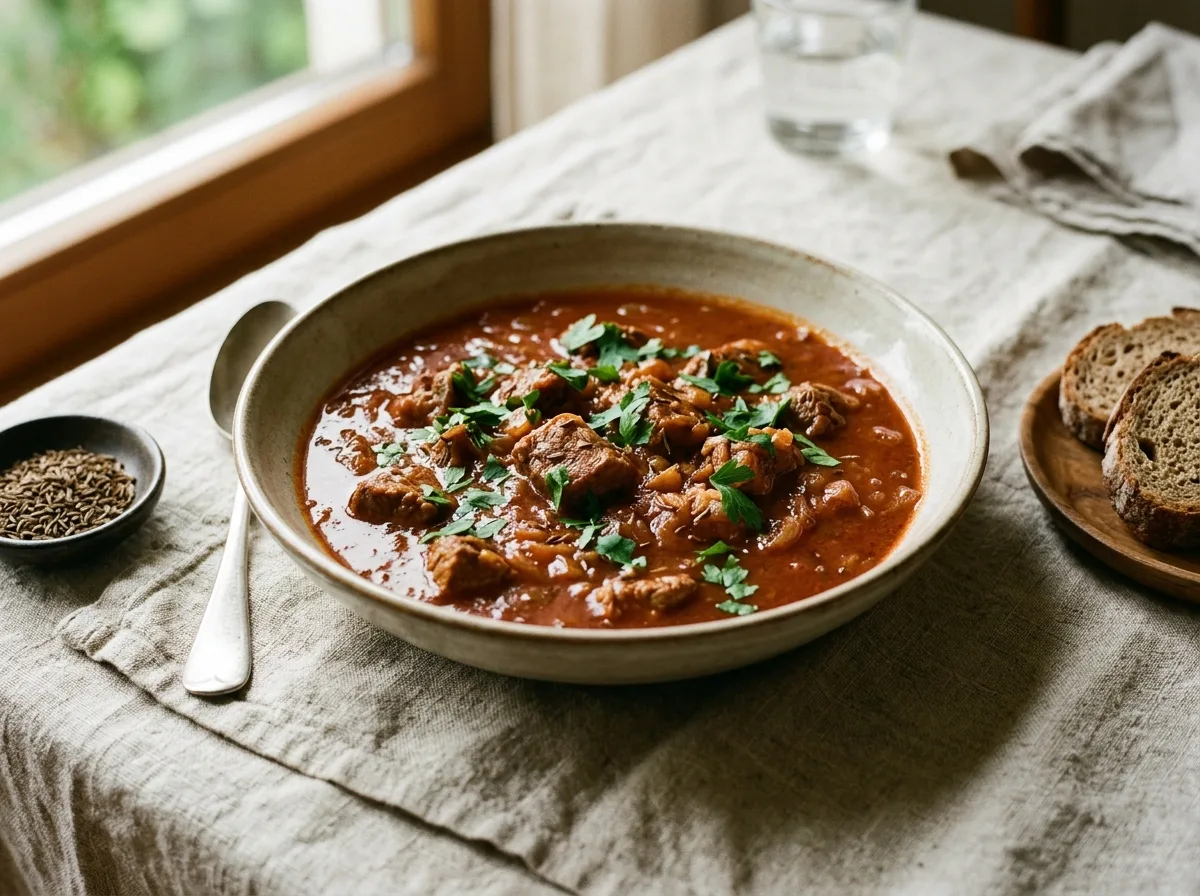
Austrian Veal Goulash with Caraway and Sweet Paprika
Rate this recipe
~$40.80 CAD total · ~$6.80 CAD per serving (estimate)
Ingredients
- 1.2 kgveal shoulder, cut into 4 cm cubes
- 60 mlolive oil
- 800 gred onions, halved and thinly sliced
- 4 clovesgarlic, minced
- 60 gsweet paprika, ground
- 1.5 tspcaraway seeds
- 1 tspfine sea salt, plus more to taste
- 0.5 tspblack pepper, freshly ground
- 2 tbsptomato paste
- 250 mlbeef or veal stock, low-sodium
- 2 tbspred wine vinegar
- 1 tbspneutral oil
- 2 tbspflat-leaf parsley, roughly chopped
Nutrition / serving
- Calories390 kcal
- Protein38 g
- Carbs14 g
- Fat19 g
- Fiber3 g
- Sodiummoderate — from the stock; use a low-sodium stock to keep it in check
Cost Estimate
~$40.80 CAD total · ~$6.80 CAD per serving (estimate)
This is the Viennese version of goulash — quieter than its Hungarian cousin, built on a deep bed of slowly melted onions and caraway rather than heat. The onions dissolve into the sauce entirely, thickening it without a gram of flour. A small pour of red wine vinegar at the end cuts through the richness and keeps every bite alive. It tastes better the next day, and the day after that.
Instructions
Sweat the onions low and slow
Warm the olive oil in a large, heavy-bottomed pot or Dutch oven over medium-low heat. Add all the sliced onions and the salt, stir to coat, then cover and cook for 25–30 minutes, stirring every 5 minutes, until the onions are completely soft, golden, and reduced to roughly a quarter of their original volume. They should look almost jammy.
Bloom the spices
Push the onions to the sides of the pot and add the neutral oil to the cleared centre. Add the caraway seeds and let them sizzle for 30 seconds until fragrant. Stir in the garlic and cook for 1 minute, then add the tomato paste and sweet paprika. Stir everything together and cook for 2 minutes over medium heat — the paprika will turn the mixture a deep brick-red and smell toasty, not raw.
Sear and combine the veal
Pat the veal cubes dry with paper towel and add them directly to the pot. Turn the heat to medium-high and stir to coat every piece in the onion-paprika base. Cook for 4–5 minutes, turning occasionally, until the meat has lost its raw pink colour on the outside. You are not looking for a hard sear — the goal is to marry the meat with the base.
Pressure cook the veal
Pour in the stock and scrape up any fond from the bottom. The liquid will look thin — that is correct; the onions body the sauce as they break down. Lock the lid and cook 25 min at high pressure, then let the pressure fall naturally for 10 min. Stovetop alternative: cover with the lid slightly ajar and braise on low for 1 hour 30 minutes.
Finish with vinegar and adjust
Remove the lid and stir in the red wine vinegar. Simmer uncovered for 5 minutes to let the sauce tighten slightly. Taste and adjust salt. The sauce should coat the back of a spoon and have a gentle, round acidity. Scatter the parsley over the top before serving.
Freeze & Reheat
Freezing: Cool the goulash completely, then portion into airtight containers. Freeze for up to 3 months. The sauce actually tightens and deepens in flavour after freezing.
Reheating: Thaw overnight in the refrigerator. Reheat gently in a covered saucepan over medium-low heat, adding a splash of water or stock if the sauce has thickened too much. Stir occasionally and heat until the veal is piping hot throughout, about 10–12 minutes.
Pressure cooker method
Total, start to finish
About 1 hr 25 min, of which roughly 35 min is active. The onions still need their slow sweat — that is the sauce, and rushing it is the one shortcut that ruins this dish.
Sweat the onions
On Sauté (low), cook all the sliced onions with the salt, covered, for 20–25 min, stirring every 5 minutes, until they are jammy and reduced to about a quarter of their volume.
Bloom and combine
Push the onions aside, sizzle the caraway in the neutral oil 30 seconds, add the garlic for 1 min, then the tomato paste and sweet paprika for 2 min until brick-red and toasty. Stir in the dried veal cubes and cook 4–5 min until the outsides lose their raw colour.
Pressure cook and finish
Add the stock, scrape the base clean, and cook 25 min at high pressure. Let the pressure fall naturally for 10 min. Stir in the red wine vinegar and reduce on Sauté about 5 min until the sauce coats a spoon. Scatter the parsley.
Chef's Cool Facts
Onions as the thickener
Austrian goulash relies on a very high ratio of onions to meat — often 1:1 by weight. As they braise, their cell walls break down completely and their natural sugars and pectin dissolve into the braising liquid, creating a sauce with body and gloss. No starch, no roux needed.
Caraway is the Austrian signature
Hungarian goulash leans on hot paprika and sometimes green peppers. The Austrian Viennese version (Wiener Saftgulasch) uses sweet paprika and caraway seeds as its defining spice. Caraway's anise-adjacent, slightly bitter note is what separates the two traditions at a single sniff.
Paprika degrades fast
Ground paprika loses its colour and aroma quickly once opened — within 6 months in a pantry, faster in a warm kitchen. For a dish where paprika is the dominant flavour, it is worth buying a fresh jar rather than using whatever has been sitting in the cupboard since last winter.
Why vinegar at the end
Adding acid early in a braise can tighten meat proteins and slow tenderising. Adding it at the end — just a few minutes before serving — preserves the brightness without interfering with the long, slow work of breaking down the veal's collagen into gelatin.