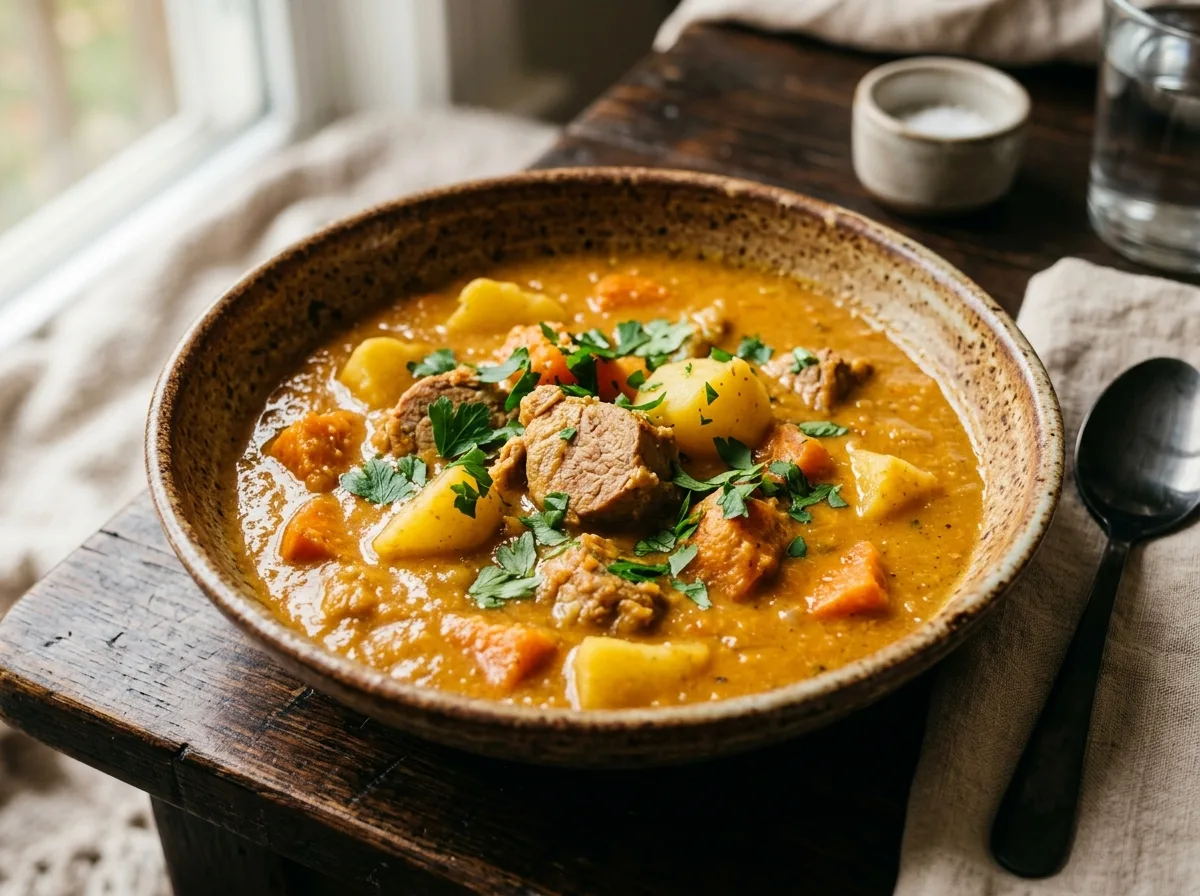
Bolivian Sopa de Maní: Peanut and Pork Soup With Real Weeknight Depth
Rate this recipe
~$4.80 CAD per serving (estimate)
Ingredients
- 300 graw unsalted peanuts, skin-on
- 800 gpork tenderloin, trimmed and cut into 4 cm chunks
- 2 tbspneutral oil (sunflower or canola)
- 1 largewhite onion, finely diced
- 4 clovesgarlic, minced
- 1 mediumred bell pepper, finely diced
- 2 mediumtomatoes, roughly chopped
- 1 tspground cumin
- 1 tspsweet paprika
- 0.5 tspdried oregano
- 1.5 litrelow-sodium chicken or pork stock
- 400 gyellow-fleshed potatoes (e.g. Yukon Gold), peeled and cut into 3 cm cubes
- 2 mediumcarrots, peeled and sliced 1 cm thick
- 1 tspfine salt, plus more to taste
- 0.5 tspblack pepper, freshly ground
- 2 tbspflat-leaf parsley, roughly chopped (to finish)
Nutrition / serving
- Calories480 kcal
- Protein38 g
- Carbs28 g
- Fat24 g
- Fiber5 g
Cost Estimate
~$4.80 CAD per serving (estimate)
Sopa de maní is Bolivia's answer to a cold evening: a thick, amber broth built on dry-roasted peanuts that are blended and strained until they dissolve into the liquid, adding body the way cream would but with a nuttier, earthier result. Pork tenderloin keeps the dish leaner than the traditional shoulder version while still braising to a tender, pull-apart texture in under an hour. The broth deepens noticeably overnight, which makes this an ideal Sunday cook for a Tuesday meal. It is almost unknown outside South America, and that is a shame worth correcting.
Instructions
Dry-toast the peanuts
Set a dry heavy-bottomed skillet over medium heat. Add the peanuts in a single layer and toast, stirring every 30 seconds, for 6–8 minutes until the skins darken and the nuts smell deeply nutty. The Maillard reaction is doing the work here — pull them off the heat before any bitter notes develop. Tip onto a plate to cool for 5 minutes.
Blend and strain the peanut base
Transfer the cooled peanuts to a blender with 500 ml of the stock. Blend on high for 90 seconds until completely smooth. Pour through a fine-mesh sieve into a bowl, pressing the solids with a spoon to extract all the liquid; discard the dry paste that remains. The strained liquid will look opaque and slightly cream-coloured — that is the emulsified peanut oil suspended in the broth.
Sear the pork
Heat the oil in a large Dutch oven or heavy pot over medium-high heat. Season the pork tenderloin chunks with half the salt and all the black pepper. Sear in a single layer for 2–3 minutes per side until golden brown on two faces; work in batches if needed to avoid crowding. Transfer to a plate — the pork will finish cooking in the broth.
Build the sofrito
Reduce the heat to medium. In the same pot, cook the onion and bell pepper for 5 minutes until softened, scraping up any browned bits. Add the garlic, tomatoes, cumin, paprika, and oregano; cook for another 3 minutes until the tomatoes collapse and the mixture smells fragrant.
Combine and simmer
Pour in the remaining 1 litre of stock and the strained peanut liquid. Stir to combine, then return the seared pork to the pot along with the potatoes and carrots. Bring to a gentle boil, then reduce to a low simmer. Cook uncovered for 35–40 minutes, stirring occasionally, until the potatoes are tender and the broth has thickened noticeably.
Season and finish
Taste the broth and adjust salt. The soup should be thick enough to coat the back of a spoon lightly — if it is too thick, add stock in 100 ml increments. Stir in the parsley just before serving.
Portion and freeze
Ladle three servings into bowls for tonight. Let the remaining three servings cool to room temperature (no more than 2 hours), then transfer to zip-lock freezer bags, press flat, label with the date, and freeze for up to 3 months.
Freeze & Reheat
Freezing: Cool completely before bagging. Press out as much air as possible and freeze flat — the bags stack efficiently and thaw faster.
Reheating: Thaw overnight in the refrigerator. Reheat in a saucepan over medium-low heat, stirring gently and adding a splash of stock or water (about 50 ml per serving) to loosen the broth back to its original consistency. The emulsified peanut fat can separate slightly if you rush the heat — keep it low and stir steadily. Do not microwave from frozen, as uneven heat breaks the emulsion.
Chef's Cool Facts
Why roasted peanuts thicken a broth
Raw peanuts blended into stock produce a thin, grassy liquid. Dry-toasting first drives off surface moisture and triggers the Maillard reaction between the peanuts' amino acids and natural sugars, creating hundreds of flavour compounds and — crucially — partially denaturing the proteins so they emulsify more readily into the broth. The result is body and depth that no raw nut can match.
Peanuts are not nuts
Botanically, the peanut (Arachis hypogaea) is a legume, not a tree nut. It originated in the lowlands of what is now Bolivia and northwestern Argentina — which makes sopa de maní, a Bolivian dish, one of the most geographically logical uses of the ingredient anywhere in the world.
Tenderloin versus shoulder in this dish
Traditional sopa de maní uses pork shoulder, which has more intramuscular fat and collagen. That collagen converts to gelatin during a long braise, adding body to the broth. Tenderloin has almost no collagen, so the peanut emulsion does the thickening work instead — and the cook time drops from 2+ hours to under 45 minutes. The trade-off is a slightly leaner, cleaner-tasting broth.
Bolivia's altitude and cooking times
La Paz sits at roughly 3,600 metres above sea level, where water boils at about 87 °C rather than 100 °C. Bolivian cooks have historically adjusted simmering times upward to compensate. At sea level or standard Canadian kitchen altitude, this recipe cooks faster than its Bolivian source versions — which is why the simmer time here is shorter than you might find in a traditional household recipe from the altiplano.