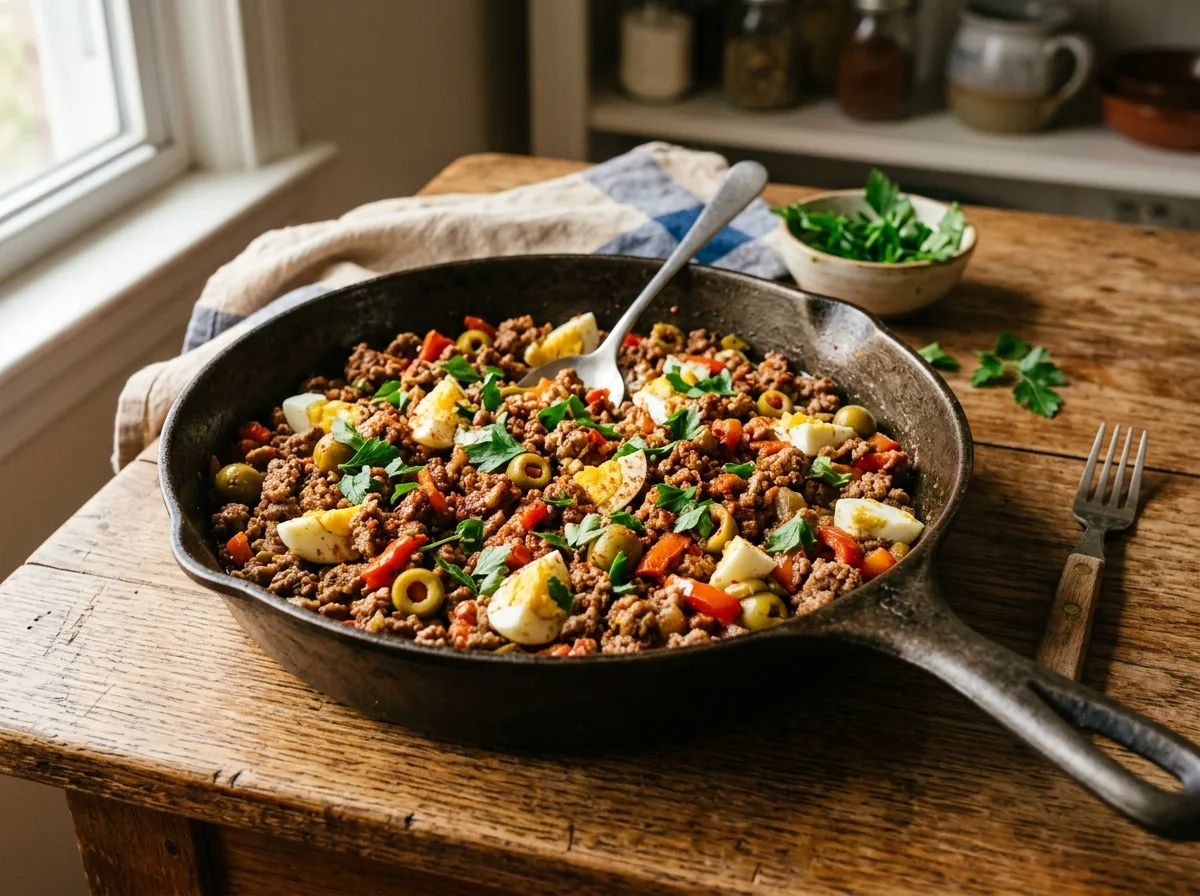
Chilean Picadillo: Ground Beef Hash That Freezes Beautifully in Batches
Rate this recipe
~$3.80 CAD per serving (estimate)
Ingredients
- 1 kglean ground beef (15–20% fat)
- 2 tbspvegetable oil
- 2 mediumyellow onions, finely diced
- 4 clovesgarlic, minced
- 1 mediumred bell pepper, finely diced
- 2 tspground cumin
- 2 tspsweet smoked paprika
- 1 tspdried oregano
- 0.5 tspblack pepper, freshly ground
- 1 tspfine salt, plus more to taste
- 2 tbsptomato paste
- 125 mldry white wine or beef stock
- 80 ggreen olives, pitted and roughly chopped
- 1 tbspolive brine (from the jar)
- 3 largeeggs
- 2 tbspflat-leaf parsley, finely chopped
Nutrition / serving
- Calories390 kcal
- Protein34 g
- Carbs7 g
- Fat24 g
- Fiber1.5 g
Cost Estimate
~$3.80 CAD per serving (estimate)
Picadillo is the kind of dish that never appears on a Chilean restaurant menu precisely because it belongs at home — stuffed into empanadas on a Sunday afternoon, spooned over white rice on a Tuesday night, or packed into a freezer container for the week ahead. The base is ground beef cooked down with onion, garlic, cumin, and sweet paprika until the pan develops a deep, meaty fond, then brightened with briny olives and finished with chopped hard-boiled egg. It costs almost nothing per serving and scales to whatever quantity your largest pan can hold. Make a full kilogram batch and you will eat well tonight and still have two portions waiting in the freezer.
Instructions
Hard-boil the eggs
Place the eggs in a small saucepan, cover with cold water, and bring to a full boil. Cook for 10 minutes, then transfer to an ice bath. Once cool, peel and chop into rough 1 cm pieces. Set aside — they go in at the very end.
Brown the beef in batches
Heat a wide, heavy skillet (at least 30 cm) over high heat until it just begins to smoke. Add the oil, then spread half the ground beef in a single layer without stirring. Let it sear undisturbed for 3–4 minutes until a deep brown crust forms on the bottom. Break it up, push it to the side, and repeat with the second half. You want colour and fond on the pan floor, not grey steamed meat.
Build the sofrito
Reduce the heat to medium. Add the diced onion and bell pepper directly to the beef fat in the pan. Cook, stirring occasionally, for 6–7 minutes until the onion is soft and translucent. Add the garlic and cook for 1 minute more until fragrant.
Add spices and tomato paste
Push everything to the edges and drop the tomato paste into the centre of the pan. Let it cook, undisturbed, for 90 seconds — it will darken slightly and smell almost sweet. Stir in the cumin, paprika, oregano, salt, and black pepper, coating the meat and vegetables evenly.
Deglaze and simmer
Pour in the white wine or stock and scrape up every bit of fond from the pan floor with a wooden spoon. Reduce the heat to medium-low and simmer uncovered for 8–10 minutes until the liquid is mostly absorbed and the mixture is moist but not soupy. Taste and adjust salt.
Finish with olives and egg
Stir in the chopped olives and the olive brine. Fold in the chopped hard-boiled egg gently — you want visible pieces, not mash. Scatter the parsley over the top and remove from heat.
Portion for eating and freezing
Serve 4 portions immediately over white rice, inside empanada dough, or stuffed into roasted peppers. Let the remaining 2 portions cool completely at room temperature (no more than 30 minutes), then transfer to airtight containers and refrigerate or freeze.
Freeze & Reheat
Freezing: Divide cooled picadillo into 200 g portions in airtight freezer containers or zip-lock bags pressed flat. Label with the date — it keeps well for up to 3 months.
Reheating from frozen: Thaw overnight in the refrigerator. Reheat in a skillet over medium heat with a splash of water or stock (about 2 tbsp) to loosen it, stirring until heated through, about 4–5 minutes. Alternatively, microwave on medium power in 90-second intervals, stirring between each, until steaming. The egg softens slightly on reheating but the flavour holds.
Chef's Cool Facts
Why the egg goes in last
Hard-boiled egg white is mostly protein that has already coagulated through cooking. Simmering it a second time in an acidic, high-heat environment breaks down its structure further, turning it rubbery and grey. Adding the egg off the heat — or in the final 60 seconds — keeps the white tender and the yolk crumbly rather than chalky.
Sweet paprika's role in Chilean cooking
Chile's culinary tradition leans on ají de color (a mild, sweet dried red pepper paste or powder) rather than the hot chiles common in Mexican or Peruvian cooking. Sweet smoked paprika is the closest widely available substitute; it provides the characteristic brick-red colour and a faint earthiness without heat, which is exactly the flavour profile Chilean cooks expect in a picadillo.
Fond is the flavour shortcut
The brown crust that forms when ground beef hits a very hot dry pan is Maillard reaction product — hundreds of new flavour compounds created when amino acids and reducing sugars react above roughly 140 °C. Stirring the meat immediately prevents this. Leaving it alone for 3–4 minutes builds a layer of fond that dissolves into the dish when you deglaze, giving the finished picadillo a depth that slow-cooked versions often lack.
Olives in South American beef dishes
Green olives in savoury meat fillings trace back to Spanish colonial cooking, where the combination of cured olives, raisins, and hard-boiled egg in ground meat was standard. Chile dropped the raisins from most regional versions but kept the olives, whose brine acts as a seasoning agent — salty, slightly acidic — that does the work of a finishing squeeze of lemon without changing the dish's character.