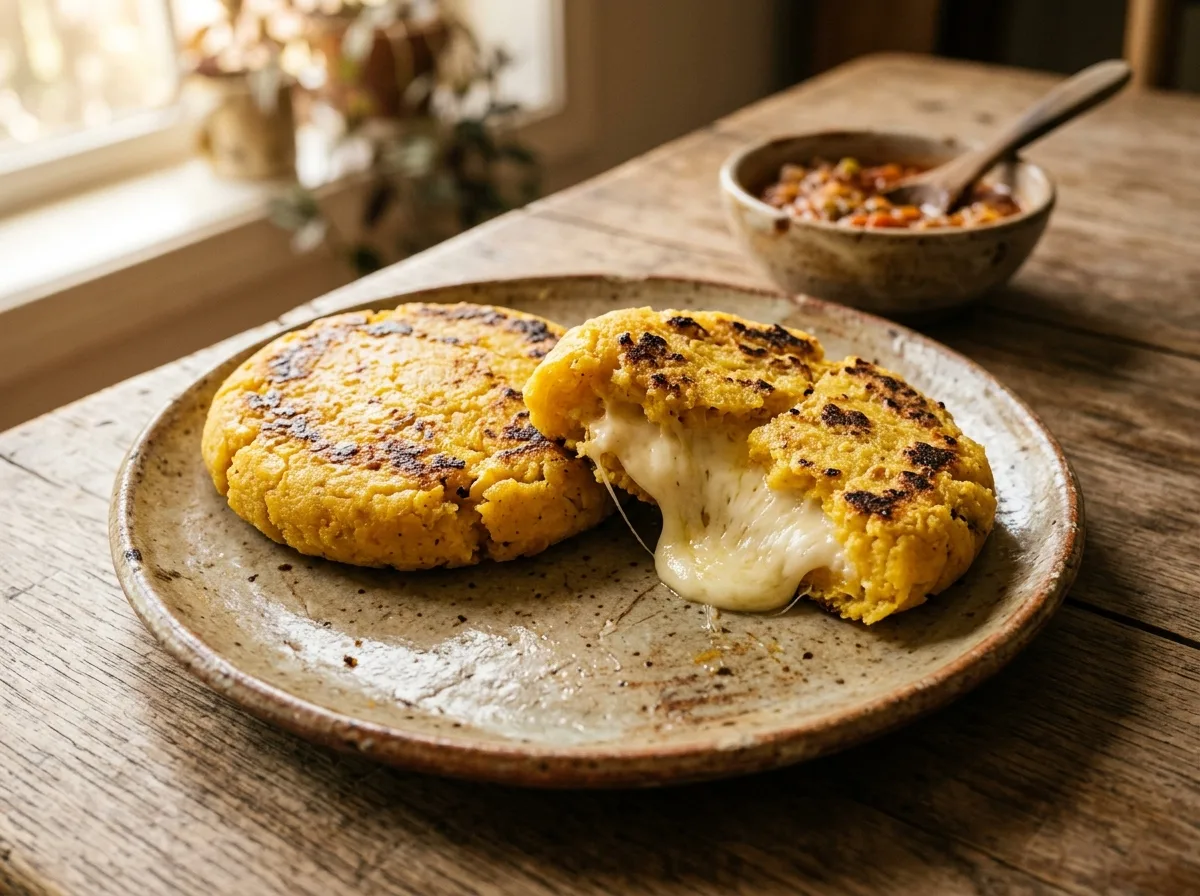
Colombian Arepas de Choclo with a Savory Cheese Core
Rate this recipe
~$1.85 CAD per serving (estimate)
Ingredients
- 500 gfrozen sweet corn kernels, thawed (or fresh kernels from 3 large ears)
- 80 gfine yellow cornmeal (masarepa or plain fine cornmeal) (adds structure; adjust by 1–2 tbsp if batter feels too wet)
- 1 tbspgranulated sugar
- 1 tspfine salt
- 30 gunsalted butter, melted
- 1 largeegg
- 200 gqueso blanco or low-moisture mozzarella, cut into 8 cubes (about 25 g each)
- 2 tbspneutral oil (sunflower or canola), for frying
Nutrition / serving
- Calories285 kcal
- Protein11 g
- Carbs31 g
- Fat13 g
- Fiber2 g
Cost Estimate
~$1.85 CAD per serving (estimate)
Arepas de choclo are a different animal from the masarepa-based arepas most people know. Instead of dried, precooked cornmeal, these are built from fresh or frozen sweet corn ground into a coarse paste — which is why they come out soft, slightly sweet, and almost custardy inside, with a golden crust that smells like caramelized corn. A pocket of melted queso blanco or low-moisture mozzarella in the center is the classic finish, and the whole thing is on the table in about 30 minutes. They keep beautifully in the freezer as uncooked patties, so you can pull them out on a weekday morning and cook them straight from frozen.
Instructions
Blend the corn paste
Put the thawed corn kernels into a food processor or blender and pulse until you have a coarse, slightly chunky paste — about 20 short pulses. You want texture, not a smooth purée; small corn pieces give the finished arepa its characteristic bite.
Mix the dough
Transfer the corn paste to a bowl and stir in the cornmeal, sugar, salt, melted butter, and egg until fully combined. The dough should hold its shape when pressed but feel soft and a little tacky. If it spreads on its own, mix in another tablespoon of cornmeal and wait 2 minutes for it to absorb.
Form the patties
Divide the dough into 8 equal portions (roughly 90 g each). Flatten one portion in your palm to a disc about 1 cm thick, press a cube of cheese into the center, then fold the edges up and over the cheese and re-flatten gently to a disc about 1.5 cm thick and 8 cm across. Seal any cracks by smoothing with wet fingertips.
Freeze or cook
To freeze: lay the unformed or formed patties on a parchment-lined tray, freeze until solid (about 2 hours), then stack with parchment between them in a zip bag. They keep for up to 2 months. To cook fresh, proceed immediately to the next step.
Pan-fry until golden
Heat 1 tbsp of oil in a non-stick or cast-iron skillet over medium heat until shimmering. Add 4 arepas, press lightly with a spatula, and cook 4–5 minutes per side until deep golden brown and the edges look set. The corn sugars caramelize quickly, so resist the urge to raise the heat — a patient medium is what gives you color without a raw center.
Cook from frozen
Place frozen arepas directly into a cold non-stick pan, add 1 tbsp oil, then set the heat to medium-low. Cook 7–8 minutes per side with the lid on for the first side to help the center thaw and the cheese melt. Remove the lid for the second side to crisp the crust.
Rest and serve
Transfer to a wire rack or plate and rest for 2 minutes before eating — the cheese inside is very hot. Serve as-is or with a spoonful of Colombian hogao (tomato-scallion sauce) or sour cream alongside.
Freeze & Reheat
Freezing uncooked patties: Freeze formed arepas on a parchment-lined tray for 2 hours, then transfer to a zip bag with parchment between each one. Keeps up to 2 months.
Cooking from frozen: No need to thaw. Place frozen arepas in a cold non-stick pan with 1 tbsp oil. Set heat to medium-low, cover, and cook 7–8 minutes on the first side. Flip, remove the lid, and cook another 7–8 minutes until deep golden and the cheese has melted through. Internal temperature should reach at least 74 °C (165 °F).
Chef's Cool Facts
Why choclo arepas taste sweeter than masarepa ones
Masarepa is made from dried, precooked dent corn — a starchy variety with very little residual sugar. Fresh or frozen sweet corn (choclo) contains sucrose that hasn't been cooked off or dried out. When you grind it into a paste and press it onto a hot pan, those sugars are right at the surface and caramelize almost immediately, which is why the crust on an arepa de choclo tastes noticeably sweeter and more complex than its masarepa cousin.
The Maillard reaction vs. caramelization on corn
Two separate browning reactions happen when an arepa hits the pan. Caramelization is pure sugar breakdown — it starts around 160 °C and produces the sweet, toffee-like notes. The Maillard reaction is different: it's a chemical reaction between amino acids and reducing sugars that begins around 140 °C and creates hundreds of flavor compounds, including the nutty, roasted aromas you notice in the first minute of cooking. Corn is rich in both sugars and the amino acid lysine, so both reactions run in parallel and reinforce each other.
A staple with pre-Columbian roots
Corn has been cultivated in the Americas for roughly 9,000 years, and ground-corn flatbreads predate European contact across the continent. In Colombia's Andean departments — particularly Antioquia and the Coffee Region — arepas de choclo made from freshly ground corn have been a morning staple for centuries, long before the industrial precooked cornmeal that now dominates urban kitchens arrived in the mid-20th century.
Why the egg and cornmeal matter structurally
Fresh corn paste is mostly water and starch with very little gluten-forming protein, so a raw patty would fall apart in the pan. The egg provides coagulating proteins that set when heated, while the small addition of dry cornmeal absorbs excess moisture and acts as a binder. Together they give the arepa enough structural integrity to flip cleanly without making the texture dense or bready.