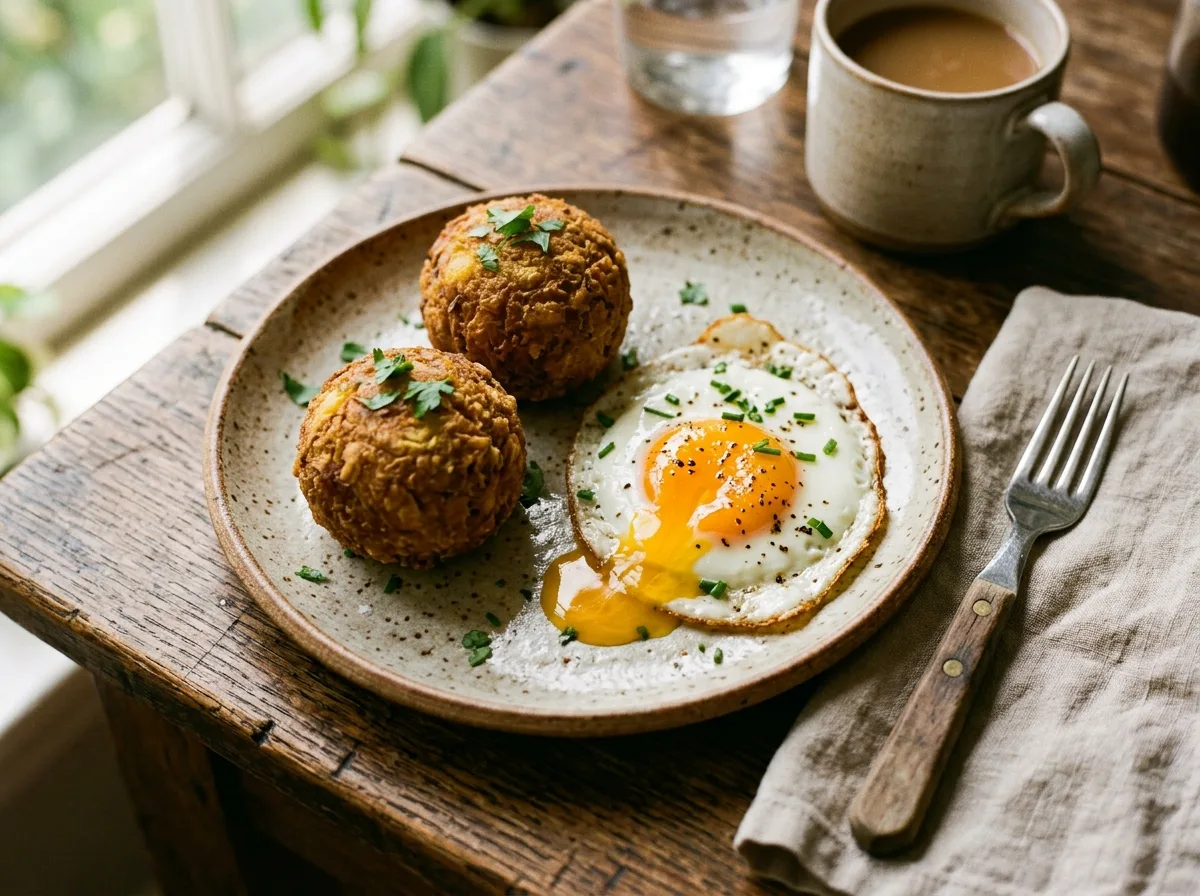
Ecuadorian Bolon de Verde
Rate this recipe
~$5.60 CAD total · ~$2.80 CAD per serving (estimate)
Ingredients
- 2 mediumgreen plantains (unripe, firm, about 400 g total peeled)
- 3spring onions, thinly sliced (whites and pale greens)
- 1 clovegarlic, minced
- 3 tbspolive oil, divided
- 3/4 tspfine sea salt, plus more for the boiling water
- 1/4 tspground cumin
- 2large eggs
Nutrition / serving
- Calories480 kcal
- Protein12 g
- Carbs62 g
- Fat21 g
- Fiber4 g
- Sodiummoderate — controlled entirely by the salt you add, so easy to dial back
Cost Estimate
~$5.60 CAD total · ~$2.80 CAD per serving (estimate)
Bolon de verde is Ecuador's answer to the question of what to do with green plantains at breakfast — and the answer is deeply satisfying. The plantains are boiled until just yielding, mashed with olive oil and spring onions, shaped into rough fist-sized balls, and pan-fried until the outside goes crisp and spotted gold. A fried egg alongside is the traditional pairing, and it earns its place: the runny yolk acts as a sauce the dish doesn't otherwise need. Fully dairy-free, built from pantry staples, and ready in under 30 minutes.
Kid-friendly tip: For younger eaters, skip the garlic and reduce the salt to 1/2 tsp. The bolones can be shaped the night before and refrigerated on a plate; just fry them straight from the fridge in the morning, adding an extra minute per side.
Instructions
Peel and boil the plantains
Cut the tips off each plantain, score the skin lengthwise in 2–3 places, and peel. Cut into 3 cm rounds and drop into a pot of well-salted boiling water. Cook for 12–15 minutes, until a fork slides in without resistance — they should feel soft all the way through, not starchy at the centre.
Sauté the spring onions
While the plantains boil, warm 1 tbsp of the olive oil in a small skillet over medium heat. Add the spring onions and garlic and cook for 2–3 minutes, stirring, until softened and fragrant but not browned. Remove from the heat.
Mash and season
Drain the plantains thoroughly and tip them into a bowl. Add the remaining 2 tbsp olive oil, the salt, and the cumin. Mash with a fork or potato masher until mostly smooth — a few small lumps are fine and give the bolones texture. Fold in the sautéed spring onions and garlic. Taste and adjust salt.
Shape the bolones
Divide the mash into 4 equal portions (roughly 90–100 g each). With lightly oiled hands, press and compact each portion into a tight ball, squeezing firmly so it holds together. If the mash feels too dry to compact, add a few drops of olive oil and work it in.
Pan-fry until crisp
Wipe out the skillet and set it over medium-high heat with a thin film of olive oil. Add the bolones and press gently to flatten slightly to about 2.5 cm thick. Fry for 3–4 minutes per side until deep golden and crisp, adjusting heat if they colour too fast. Transfer to a plate.
Fry the eggs and serve
In the same pan, fry the eggs over medium heat to your liking — sunny-side up with a runny yolk is traditional. Serve 2 bolones per person with one egg alongside, letting the yolk break over the crisp surface at the table.
Freeze & Reheat
The shaped, uncooked bolones freeze well. Place them on a parchment-lined tray, freeze until solid (about 1 hour), then transfer to a bag. Cook from frozen in a lightly oiled skillet over medium heat, covered, for 5 minutes per side, then uncover and crisp for 2 more minutes per side. The fried eggs are always made fresh.
Chef's Cool Facts
Green vs. ripe: a starch question
Unripe green plantains are high in resistant starch — a type the small intestine can't digest, which feeds gut bacteria and blunts the blood-sugar spike compared to ripe plantains. As the fruit ripens and yellows, enzymes convert that resistant starch to simple sugars, which is why a green bolon tastes starchy and savoury while a ripe one would turn sweet and soft.
Bolon as street food
In Ecuador, bolones are sold from roadside carts in the coastal region from early morning — typically before 9 a.m. — because green plantains are the staple starch of the Costa, the Pacific lowland zone, not the Andes. The Andean highlands have their own morning starch traditions built around potato and corn.
Why the ball holds together
Green plantain mash is naturally sticky because its starch granules, when cooked and then worked while still warm, release enough gelatinised starch to act as a binder. No egg, no flour, no cheese needed — the plantain is its own glue, which is why the mash must be shaped while it is still hot.