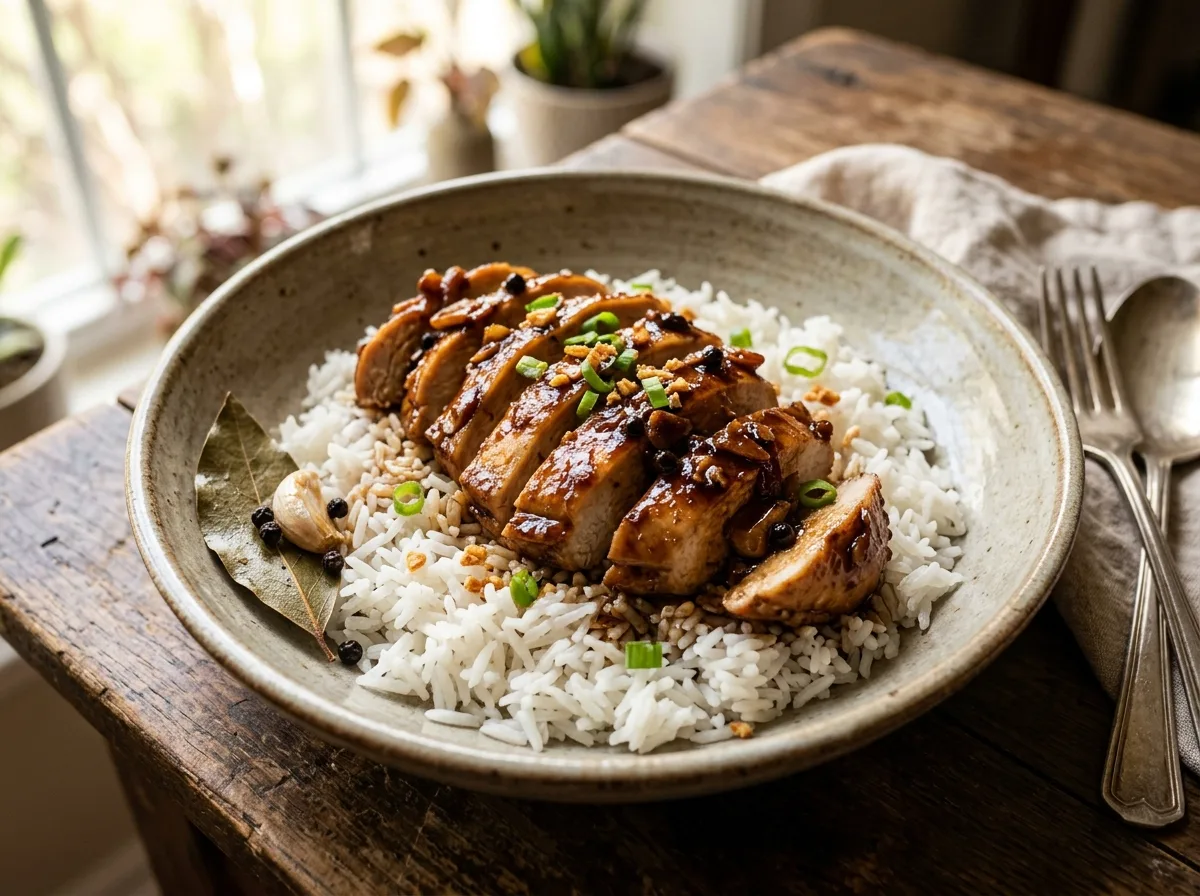
Filipino Chicken Breast Adobo
Rate this recipe
~$25.20 CAD total · ~$4.20 CAD per serving (estimate)
Ingredients
- 1.2 kgboneless, skinless chicken breasts (about 4 large)
- 1 headgarlic, cloves separated and lightly crushed (unpeeled)
- 120 mlcane vinegar (sukang maasim) or white cane vinegar
- 80 mlsoy sauce (regular, not low-sodium)
- 80 mlwater
- 1 tbspolive oil
- 1 tspwhole black peppercorns
- 4 wholedried bay leaves
- 1 tspgranulated sugar
Nutrition / serving
- Calories285 kcal
- Protein42 g
- Carbs7 g
- Fat7 g
- Fiber0.5 g
- Sodiumhigh — from the soy sauce; use a reduced-sodium soy if you are watching intake, but expect a slightly thinner glaze
Cost Estimate
~$25.20 CAD total · ~$4.20 CAD per serving (estimate)
Adobo is the dish that taught the world Filipino cooking is built on precision, not excess. Cane vinegar and soy sauce do the heavy lifting — souring, salting, and preserving all at once — while a full head of garlic and a few bay leaves turn the braising liquid into something you'll want to spoon over everything. The trick with breast meat is restraint: a hard sear, then a short, gentle braise, and you pull it off the heat before it has any chance to dry out. The sauce reduces to a dark, lacquered glaze that clings to each slice.
Instructions
Pound and season the chicken
Place the chicken breasts between two sheets of plastic wrap and pound the thicker end gently to an even 2.5 cm thickness — this ensures the breast cooks through in the short braise without the thin end drying out. Pat dry with paper towel; do not salt, the soy sauce will do that.
Mix the braising liquid
Stir together the cane vinegar, soy sauce, water, and sugar in a small bowl until the sugar dissolves. Set aside near the stove.
Sear the chicken
Heat the olive oil in a wide, heavy skillet or sauté pan over medium-high heat until the oil just begins to shimmer. Add the chicken breasts smooth-side down and sear undisturbed for 3 minutes until deep golden. Flip and sear the second side for 2 minutes — the centre will still be raw at this point, which is correct.
Add aromatics and liquid
Reduce the heat to medium-low. Scatter the crushed garlic cloves and peppercorns around the chicken, add the bay leaves, then pour the braising liquid over everything. The liquid should come about halfway up the sides of the breast — if not, add a splash more water.
Braise gently
Cover the pan and simmer on medium-low for 10 minutes, turning the chicken once at the halfway mark. The internal temperature should reach 74 °C on an instant-read thermometer; the meat will feel just firm, not springy. Remove the chicken to a cutting board and tent loosely with foil.
Reduce the glaze
Raise the heat to medium-high and boil the braising liquid uncovered for 4–5 minutes, stirring occasionally, until it reduces by roughly half and turns dark, syrupy, and glossy. It should coat a spoon. Remove the bay leaves.
Slice and serve
Slice the chicken breasts against the grain into 1.5 cm pieces and arrange over steamed rice. Spoon the garlic-studded glaze generously over the top; the crushed cloves are soft enough to eat and worth keeping.
Freeze & Reheat
Freezing: Cool the sliced chicken and glaze together in an airtight container. Freeze for up to 3 months. The vinegar in the braising liquid acts as a natural preservative and the glaze actually deepens in flavour after freezing.
Reheating: Thaw overnight in the refrigerator. Reheat gently in a covered skillet over medium-low heat with 2 tbsp of water to loosen the glaze, about 5 minutes. Avoid the microwave if you can — it tightens the breast meat.
Chef's Cool Facts
Vinegar as preservative
Cane vinegar drops the pH of the braising liquid low enough to inhibit bacterial growth — the same principle behind pickling. Filipino cooks historically made adobo without refrigeration precisely because the acid and salt together created a hostile environment for spoilage organisms. The dish kept for days at room temperature in a warm climate.
Why unpeeled garlic?
Leaving the papery skin on the garlic cloves during the braise is traditional and practical. The skin acts as a slow-release wrapper, letting the cloves soften gradually rather than dissolving into the sauce. By the time the glaze is ready, each clove is buttery and mild — nothing like raw garlic — and the skins slip off easily on the plate.
Cane vs. white vinegar
Sukang maasim (Filipino cane vinegar) is made from fermented sugarcane juice. It is milder and slightly sweeter than distilled white vinegar, with a faint grassy note that rounds out the soy sauce. If you substitute regular white vinegar, reduce the quantity by about 20 ml and add a small pinch of sugar to compensate for the sharper acidity.
The Maillard glaze
The dark colour of a finished adobo glaze comes from two sources: the Maillard browning on the seared chicken that dissolves back into the liquid, and the caramelisation of the soy sauce solids as the liquid reduces. Neither is burnt — both are deliberate, and together they give the sauce its characteristic depth.