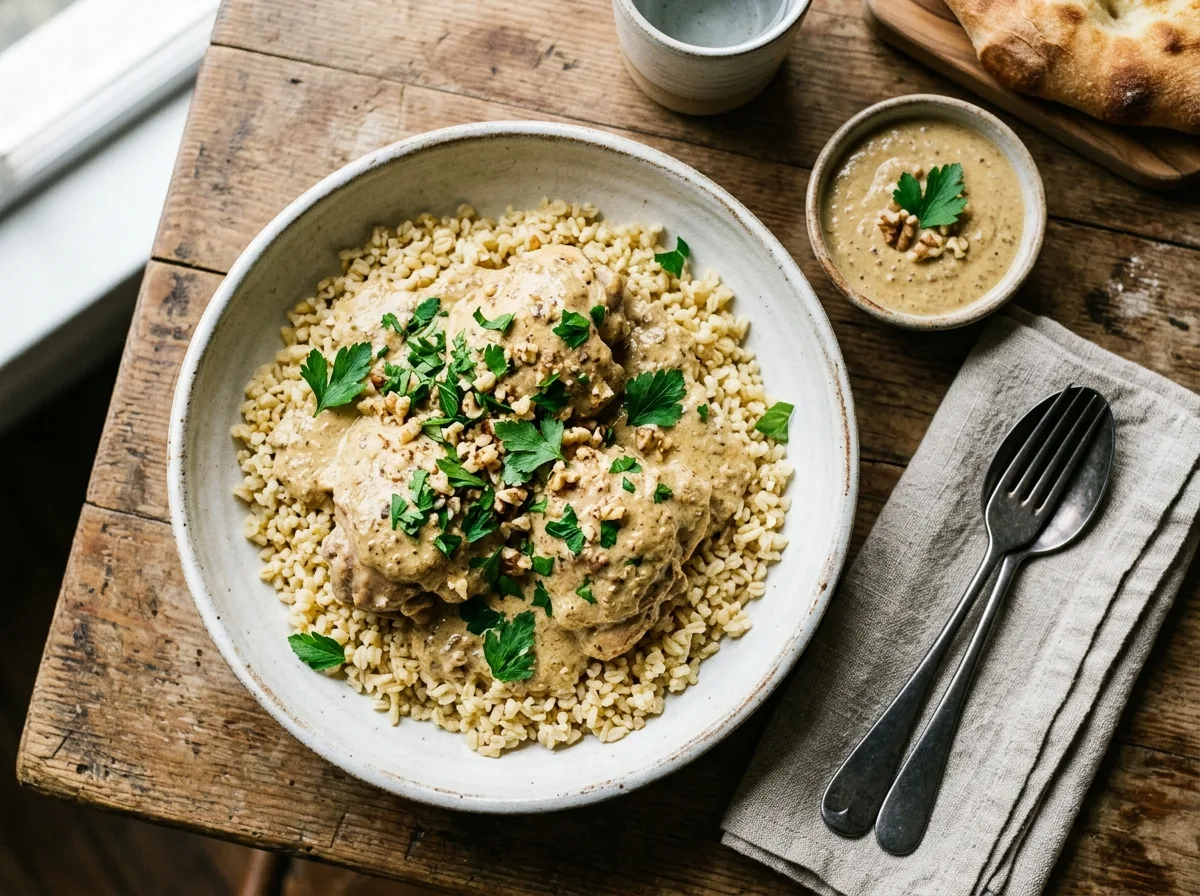
Georgian Chicken Breast Satsivi in Walnut and Coriander Sauce
Rate this recipe
~$28.80 CAD total · ~$4.80 CAD per serving (estimate)
Ingredients
- 1.2 kgboneless, skinless chicken breasts
- 1.5 Lcold water
- 1 tspfine salt, for poaching
- 1 wholebay leaf
- 5 wholeblack peppercorns
- 300 graw walnut halves
- 4 clovesgarlic
- 1 mediumyellow onion, roughly chopped
- 2 tbspolive oil
- 2 tspground coriander
- 1.5 tspblue fenugreek (utskho suneli)
- 0.5 tspground turmeric
- 0.25 tspcayenne pepper
- 2 tbspwhite wine vinegar
- 1 tspfine salt, for the sauce
- 350 mlreserved poaching liquid (warm)
- 300 gmedium bulgur
- 2 tbspfresh flat-leaf parsley, chopped (for serving)
Nutrition / serving
- Calories545 kcal
- Protein46 g
- Carbs38 g
- Fat22 g
- Fiber5 g
- Sodiummoderate — controlled by the poaching salt and the sauce salt you add yourself
Cost Estimate
~$28.80 CAD total · ~$4.80 CAD per serving (estimate)
Satsivi is one of those dishes where the sauce is the point — a cold-finished walnut paste, fragrant with blue fenugreek and ground coriander, that thickens as it cools into something almost custard-like without a drop of dairy. The chicken breasts poach gently in seasoned water, then rest in the sauce overnight, which is when the flavour actually arrives. Serve it over bulgur so nothing goes to waste.
Instructions
Poach the chicken
Place the chicken breasts in a single layer in a wide saucepan. Cover with the cold water, add the salt, bay leaf, and peppercorns, and bring slowly to a bare simmer over medium heat — you want lazy bubbles, not a rolling boil. Poach for 18–22 minutes, until the thickest part reads 74 °C on an instant-read thermometer. Transfer the breasts to a plate and reserve the poaching liquid; discard the bay leaf.
Soften the onion
While the chicken poaches, warm the olive oil in a small skillet over medium-low heat. Add the chopped onion and cook, stirring occasionally, for 10–12 minutes until soft and translucent but not coloured. Add the garlic and cook for another 90 seconds until fragrant. Remove from the heat.
Grind the walnuts
Pulse the walnuts in a food processor until they reach a coarse, damp meal — think wet sand, not walnut butter. Stop before the oils fully release or the sauce will be greasy. Tip into a large bowl.
Build the sauce base
Add the softened onion and garlic to the food processor and blend to a paste. Scrape into the bowl with the walnuts. Stir in the ground coriander, blue fenugreek, turmeric, cayenne, white wine vinegar, and 1 tsp salt until everything is combined into a thick, fragrant paste.
Loosen with poaching liquid
Ladle the warm (not boiling) poaching liquid into the walnut paste in three additions, stirring vigorously after each, until the sauce is pourable but still substantial — roughly the consistency of heavy cream. You may not need all 350 ml. Taste and adjust salt and vinegar.
Shred and combine
Tear or slice the cooled chicken breasts into large pieces and fold them into the sauce. The sauce will look thin at this stage; that is correct. Cover and refrigerate for at least 2 hours, or overnight — the walnuts absorb the liquid and the sauce firms around the chicken as it cools.
Cook the bulgur
Bring 600 ml of lightly salted water to a boil. Stir in the bulgur, cover tightly, reduce the heat to the lowest setting, and cook for 12 minutes. Remove from the heat and let it steam, still covered, for 5 minutes, then fluff with a fork.
Serve
Spoon the satsivi — cold or at cool room temperature — over the bulgur. Scatter chopped parsley over each bowl. Do not reheat the sauce above 60 °C or the walnut emulsion will break.
Freeze & Reheat
Freezing: Portion the two freezer servings (chicken and sauce together, without bulgur) into airtight containers. Freeze for up to 2 months.
Reheating: Thaw overnight in the refrigerator. Serve cold or warm gently in a saucepan over low heat, stirring, until just heated through — pull it off the heat at 55–60 °C. Cook fresh bulgur to serve alongside; frozen bulgur turns gummy.
Chef's Cool Facts
Why the sauce sets as it cools
Walnuts are roughly 65% fat, but they also contain proteins and fibre that act as natural emulsifiers. As the sauce cools, those proteins tighten around the fat droplets and the starch-like fibre absorbs the poaching liquid, turning a thin, pourable sauce into a thick, almost sliceable one — no gelatin, no dairy, no roux required.
Blue fenugreek is not regular fenugreek
Utskho suneli — Georgian blue fenugreek — comes from a different plant species (Trigonella caerulea) than the Indian fenugreek on most spice racks. It is milder, less bitter, and carries a hay-like sweetness that is central to the Georgian spice blend khmeli suneli. Substituting Indian fenugreek will make the sauce noticeably more bitter; if you cannot source the Georgian variety, reduce the quantity by half.
Satsivi as a preservation technique
Before refrigeration, the high fat content of the walnut sauce and the acidity from vinegar acted as a short-term preservative for cooked poultry — a practical reason the dish was traditionally made in large batches and served over several days. The flavour improvement with time was a happy consequence of a food-safety strategy.
Coriander seed, not leaf
Georgian cuisine uses ground coriander seed as a foundational spice rather than a garnish, often in larger quantities than South Asian or Mexican cooking. The seed's warm, citrusy flavour compounds (linalool and geraniol) are fat-soluble, which means they bloom and bind into the walnut oil rather than dispersing into water — one reason the sauce tastes more complex than its short ingredient list suggests.