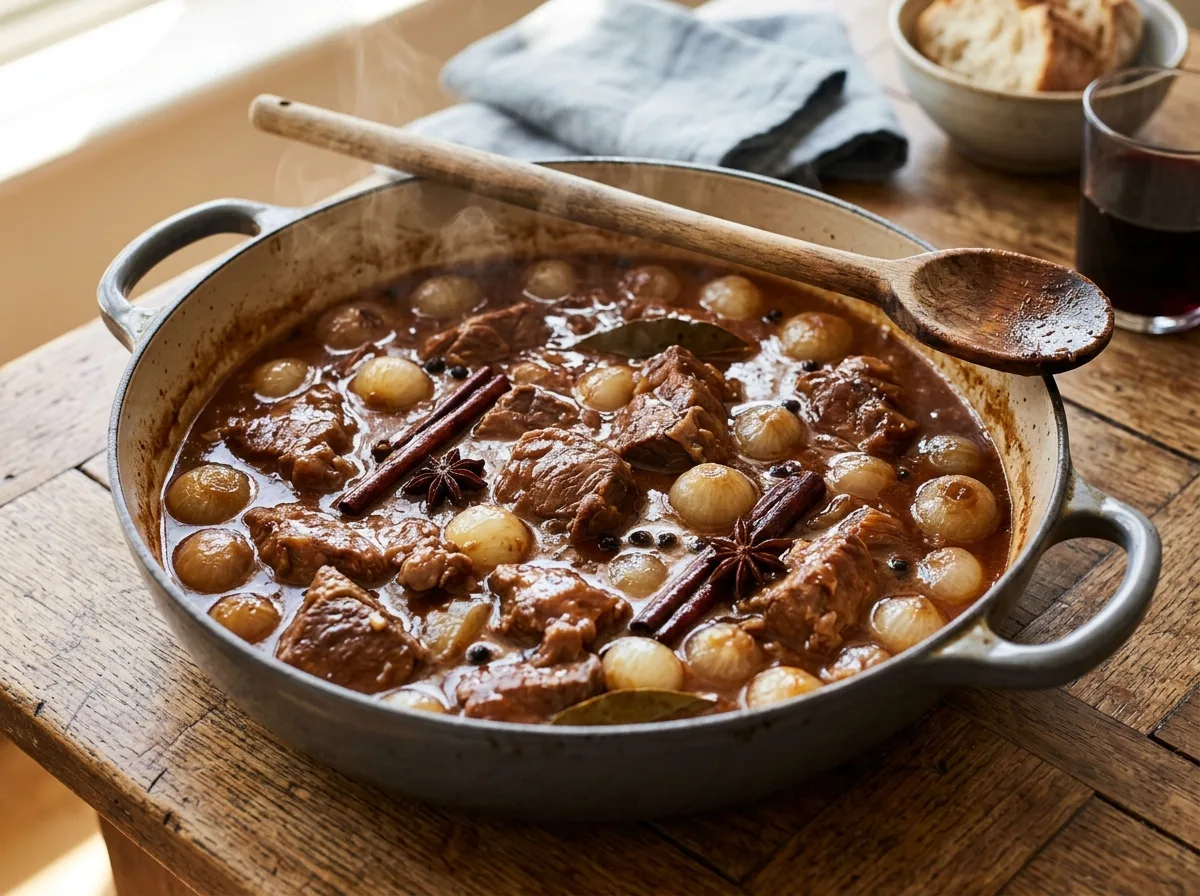
Greek Veal Stifado with Pearl Onions and Cinnamon
Rate this recipe
~$40.80 CAD total · ~$6.80 CAD per serving (estimate)
Ingredients
- 1.2 kgveal shoulder, cut into 5 cm cubes
- 500 gpearl onions, peeled (fresh or frozen)
- 1 whole headgarlic, cloves separated and peeled
- 400 mldry red wine
- 60 mlred wine vinegar
- 400 gcanned whole peeled tomatoes, crushed by hand
- 60 mlolive oil
- 1 stickcinnamon (about 8 cm)
- 4 wholeallspice berries
- 2 wholecloves
- 1 wholestar anise
- 2 wholebay leaves
- 1 tspground cinnamon
- 1 tspfine sea salt
- 0.5 tspfreshly ground black pepper
- 1 tbsptomato paste
Nutrition / serving
- Calories385 kcal
- Protein38 g
- Carbs14 g
- Fat16 g
- Fiber2.5 g
- Sodiummoderate — from the salt and tomatoes only; no added stock
Cost Estimate
~$40.80 CAD total · ~$6.80 CAD per serving (estimate)
Stifado is one of those braises that rewards patience without demanding much of your afternoon — forty minutes of hands-on work, then the oven does the rest. Veal shoulder turns fork-tender in a sauce built on red wine, red wine vinegar, and whole spices, while the pearl onions dissolve just enough to thicken everything naturally. The cinnamon and allspice read as warmth rather than sweetness, and the vinegar keeps the whole pot from feeling heavy. It freezes beautifully, and the two portions you pull from the freezer a month from now will taste rounder than the day you made them.
Instructions
Sear the veal
Pat the veal cubes dry with paper towel — moisture is the enemy of colour. Heat the olive oil in a wide, heavy-bottomed pot or Dutch oven over medium-high heat. Working in two batches, sear the veal for 3–4 minutes per side until deeply browned. Transfer to a plate and set aside; do not crowd the pan.
Soften the aromatics
Reduce the heat to medium. Add the pearl onions and garlic cloves to the same pot and cook, stirring occasionally, for 5–6 minutes until the onions pick up some colour at the edges. Stir in the tomato paste and cook for 1 minute until it darkens slightly and smells sweet.
Deglaze and build the braise
Pour in the red wine and red wine vinegar, scraping up any browned bits from the bottom of the pot. Add the crushed tomatoes, cinnamon stick, allspice berries, cloves, star anise, bay leaves, ground cinnamon, salt, and pepper. Stir to combine.
Return the veal and bring to a simmer
Nestle the seared veal back into the pot, along with any resting juices. The liquid should come about two-thirds of the way up the meat — add a splash of water if needed. Bring to a gentle simmer over medium heat.
Pressure cook
Lock the lid and cook 30 min at high pressure, then let the pressure fall naturally for 15 min, until the veal yields to a fork without resistance. Oven alternative: cover tightly and braise at 160 °C (325 °F) for 1 hour 45 minutes to 2 hours, checking once at the halfway point and adding 60 ml of water if it looks dry.
Reduce and finish
Remove the lid, discard the cinnamon stick, bay leaves, star anise, allspice berries, and cloves. Return the pot to the stovetop over medium heat and simmer uncovered for 8–10 minutes until the sauce thickens to a glossy, coating consistency. Taste and adjust salt.
Rest and serve
Let the stifado rest off the heat for 10 minutes before serving — the sauce tightens further as it sits. Serve over orzo, crusty bread, or mashed potatoes, with the braising juices spooned generously over the top.
Freeze & Reheat
Freezing: Cool the stifado completely, then portion into airtight containers. Freeze for up to 3 months. The sauce actually deepens in flavour after freezing as the spices continue to meld.
Reheating: Thaw overnight in the refrigerator. Reheat gently in a covered saucepan over low heat, adding 2–3 tbsp of water if the sauce has thickened too much. Stir occasionally and heat until the veal is warmed through, about 12–15 minutes. Do not boil — it will toughen the meat.
Pressure cooker method
Total, start to finish
About 1 hr 35 min, of which roughly 40 min is active.
Sear and soften
On Sauté (high), sear the dried veal cubes in two batches until deeply browned and lift them out. Cook the pearl onions and garlic 5–6 min until coloured at the edges, then the tomato paste for 1 min.
Pressure cook
Deglaze with the red wine and vinegar, scraping the base clean, then add the crushed tomatoes, cinnamon stick, allspice, cloves, star anise, bay, ground cinnamon, salt and pepper. Return the veal and cook 30 min at high pressure, letting the pressure fall naturally for 15 min.
Reduce and rest
Discard the whole spices and bay. Reduce on Sauté 8–10 min until the sauce is glossy and coats a spoon, then rest off the heat 10 min before serving — it tightens further as it sits.
Chef's Cool Facts
Why vinegar belongs in a braise
Red wine vinegar does two things here: its acidity breaks down collagen in the veal shoulder faster than wine alone, and it balances the natural sweetness the pearl onions release as they cook down. Without it, the sauce can read as flat and one-dimensional.
Pearl onions as a thickener
Stifado traditionally uses a large quantity of onions relative to the meat — sometimes a 1:1 ratio by weight. As they braise, the onions' cell walls break down and release pectin and sugars directly into the sauce, giving it body without any flour or starch.
Cinnamon in savoury Greek cooking
The use of cinnamon in Greek meat dishes traces back to Byzantine cuisine, which drew heavily on Persian spice routes. In stifado, it functions as a background note rather than a dominant flavour — the whole stick releases its oils slowly, which is why removing it before serving prevents the dish from tasting like dessert.
Why the freezer improves this dish
Braised collagen-rich cuts like veal shoulder contain gelatin that sets when cold and re-melts on reheating. A freeze-thaw cycle also allows the fat to separate cleanly and the spice compounds to redistribute more evenly through the sauce — a phenomenon food scientists call flavour equilibration.