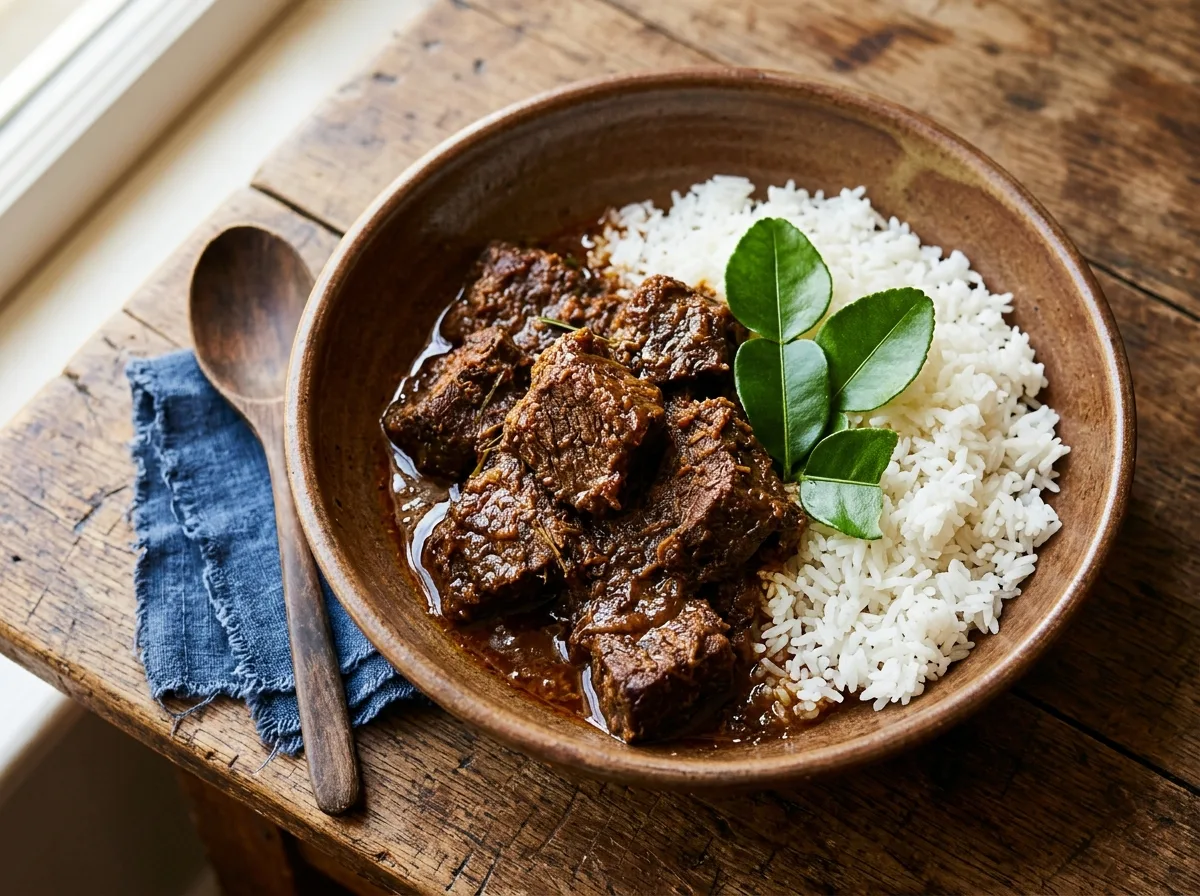
Indonesian Beef Rendang
Rate this recipe
~$34.80 CAD total · ~$5.80 CAD per serving (estimate)
Ingredients
- 1.2 kgbeef chuck, cut into 5 cm cubes
- 6 wholeshallots, peeled and roughly chopped
- 6 clovesgarlic, peeled
- 5 wholelong red chillies, deseeded for medium heat or left whole for hot
- 3 wholebird's eye chillies (optional, for extra heat)
- 30 gfresh galangal, peeled and sliced (or 2 tsp ground galangal)
- 20 gfresh ginger, peeled and sliced
- 1 tspground turmeric
- 1 tspground coriander
- 1 tspground cumin
- 3 stalkslemongrass, white part only, bruised and tied in a knot
- 4 wholekaffir lime leaves (fresh or frozen)
- 2 wholedried bay leaves
- 1 wholecinnamon stick
- 3 wholecloves
- 3 wholecardamom pods, lightly crushed
- 800 mlfull-fat coconut milk (2 × 400 ml cans)
- 40 gdesiccated coconut, unsweetened
- 2 tbspolive oil
- 1.5 tspfine salt, plus more to taste
- 1 tsppalm sugar or brown sugar
Nutrition / serving
- Calories520 kcal
- Protein38 g
- Carbs12 g
- Fat36 g
- Fiber2 g
- Sodiummoderate — from salt only; adjust to taste
Cost Estimate
~$34.80 CAD total · ~$5.80 CAD per serving (estimate)
Rendang is patience made edible. Beef chuck simmers in a spiced coconut milk paste — lemongrass, galangal, fresh chilli, shallots — until the liquid is completely gone and the meat fries in its own rendered fat and coconut oil. That dry-fry finish is not optional; it is what concentrates the flavour and gives the exterior its characteristic dark, almost lacquered crust. The fat also seals the meat as it cools, making this one of the most freezer-stable dishes you can batch-cook.
Instructions
Toast the coconut
Set a dry skillet over medium-low heat. Add the desiccated coconut and stir constantly for 3–4 minutes until it turns a deep golden brown and smells nutty. Tip immediately onto a plate to stop cooking; it will continue to darken in the pan if left. Set aside.
Build the spice paste
Combine shallots, garlic, both chillies, galangal, ginger, turmeric, coriander, and cumin in a blender or food processor. Add 60 ml of the coconut milk and blitz to a smooth paste, scraping down the sides as needed. The paste should be thick and fragrant.
Fry the paste
Heat the olive oil in a large, heavy-bottomed pot or Dutch oven over medium heat. Add the spice paste and fry, stirring frequently, for 6–8 minutes until it darkens slightly, smells cooked rather than raw, and the oil begins to separate around the edges.
Add the whole aromatics
Add the lemongrass, kaffir lime leaves, bay leaves, cinnamon stick, cloves, and cardamom pods. Stir for 1 minute until fragrant.
Add beef and coconut milk
Add the beef cubes and turn them in the paste until every piece is coated. Pour in the remaining coconut milk, add the salt and sugar, and stir to combine. Bring to a gentle boil.
Pressure cook the beef
Lock the lid and cook 20 min at high pressure, then let the pressure fall naturally for 10 min. This replaces the long simmer for tenderness only — the sauce still has to be reduced by hand afterwards, which is where rendang gets its character. Stovetop alternative: cook uncovered on medium-low for 2 to 2.5 hours, stirring every 15–20 minutes.
Reduce, then dry-fry
Return to Sauté (medium) and reduce uncovered for about 25 min, stirring more often as it thickens. Stir in the toasted coconut and keep going another 15 min, stirring almost constantly, until the liquid has gone completely and the meat fries in the released coconut fat and turns deep mahogany. This is the defining moment — do not rush it or add water. The pot will look alarmingly dry just before it is done.
Rest and taste
Remove the lemongrass, cinnamon stick, cardamom pods, and bay leaves. Taste and adjust salt. Let the rendang rest uncovered for 10 minutes before serving — the flavour deepens as it sits. Serve with steamed jasmine rice, brown rice, or cauliflower rice.
Freeze & Reheat
Freezing: Cool completely, then divide into portions in airtight containers or zip-lock bags. The fat layer that forms on top acts as a natural seal. Freeze for up to 3 months.
Reheating: Thaw overnight in the fridge. Reheat gently in a covered pan over medium-low heat with 2–3 tbsp of water, stirring occasionally, until piping hot throughout. The texture holds exceptionally well — the dry-fry finish means there is no sauce to break or separate.
Pressure cooker method
Total, start to finish
About 1 hr 50 min, of which roughly 40 min is active. The pressure cooker takes over the tenderising, not the reduction — the last stretch is hands-on by nature and cannot be skipped.
Toast, blend, fry
Toast the coconut in a dry pan 3–4 min and set aside. Blend the shallots, garlic, chillies, galangal, ginger, turmeric, coriander and cumin with 60 ml of the coconut milk. On Sauté (medium), fry the paste in the olive oil 6–8 min until the oil separates, then add the lemongrass, lime leaves, bay, cinnamon, cloves and cardamom for 1 min.
Pressure cook
Coat the beef in the paste, add the remaining coconut milk, salt and sugar, and cook 20 min at high pressure. Let the pressure fall naturally for 10 min — a quick release here will toughen the beef.
Reduce and dry-fry
Back on Sauté (medium), reduce uncovered about 25 min, then add the toasted coconut and stir almost constantly for a final 15 min until the fat separates and the meat browns. Rest 10 min off the heat before serving.
Chef's Cool Facts
Why rendang keeps so well
Traditional rendang was developed in West Sumatra partly as a preservation technique. Cooking out all the moisture and then frying the meat in its own fat creates an environment hostile to bacterial growth. Before refrigeration, a well-made rendang could last two weeks at room temperature in a tropical climate.
The science of the dry-fry finish
As the last of the coconut milk evaporates, the coconut fat that remains reaches temperatures above 150 °C — well above what a water-based liquid allows. This is the Maillard reaction in action: the meat surface browns, new flavour compounds form, and the spice paste caramelises directly onto the beef rather than staying in a sauce around it.
Galangal is not ginger
Galangal and ginger are cousins in the Zingiberaceae family, but galangal has a sharper, more piney, almost medicinal flavour. Substituting ginger gives a different result — acceptable, but noticeably milder and sweeter. Fresh galangal freezes well; buy a large piece and grate it from frozen when needed.
Kaffir lime leaves and their double life
The kaffir lime tree produces both a wrinkled, intensely aromatic fruit rind and leaves used throughout Southeast Asian cooking. The leaves contain volatile oils — citronellal and limonene — that survive long cooking and give rendang its faint citrus undercurrent even after hours on the stove.