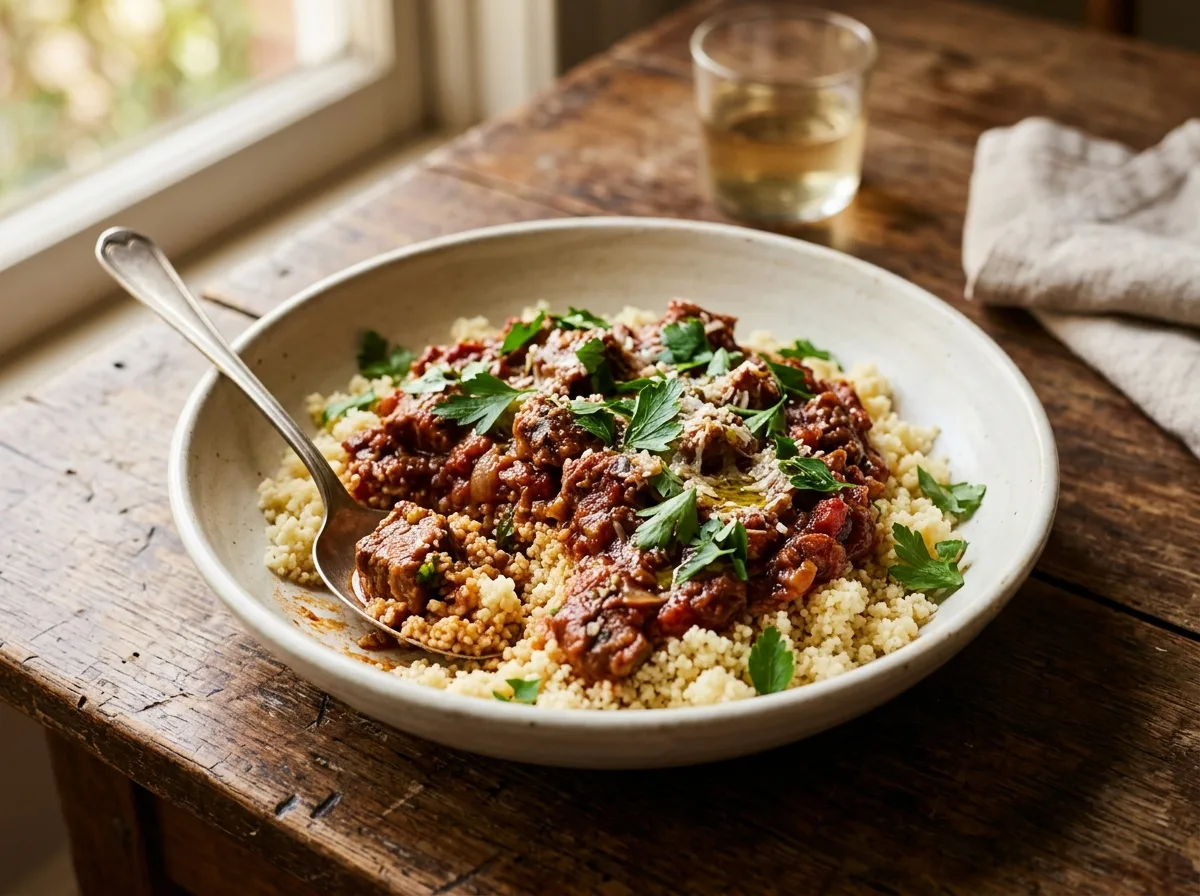
Italian Pork Ragù with Couscous
Rate this recipe
~$4.20 CAD per serving (estimate)
Ingredients
- 30 mlolive oil
- 900 gground pork (from a Costco family pack; remainder frozen for another meal)
- 1 largeyellow onion, finely diced
- 6 clovesgarlic, minced
- 2 tspfennel seeds
- 1 tspchili flakes
- 1 tspdried oregano
- 30 mltomato paste
- 800 gcrushed tomatoes, canned (one standard 796 ml / 28 oz can)
- 150 mldry white wine (or water with a squeeze of lemon)
- 1 tspfine sea salt, divided
- ½ tspblack pepper
- 360 gcouscous, dry (medium-grain)
- 480 mlboiling water
- 15 mlolive oil (for finishing the couscous)
- 15 gfresh flat-leaf parsley, roughly chopped (optional garnish)
Nutrition / serving
- Calories545 kcal
- Protein34 g
- Carbs52 g
- Fat19 g
- Fiber4 g
Cost Estimate
~$4.20 CAD per serving (estimate)
Ground pork browns hard — not stirred, not rushed — until the pan has a dark, caramelized fond. That foundation, plus fennel seed, chili flake, and a long pour of crushed tomatoes, is what makes this ragù taste like it cooked all afternoon when it actually took forty minutes. Couscous soaks up the sauce in five minutes flat and keeps service fast on a weekday. The ragù freezes in two-serving blocks with no quality loss, so the Costco family pack earns its place.
Instructions
Sear the pork hard
Heat 30 ml olive oil in a large, heavy-bottomed pot or Dutch oven over high heat until it shimmers. Add the ground pork in one layer and press it flat. Leave it completely undisturbed for 3–4 minutes until the bottom is deeply browned and pulls away from the pot easily. Break it apart and continue cooking for another 3 minutes, again resisting the urge to stir constantly, until most of the pink is gone and you have good color throughout.
Build the aromatics
Reduce heat to medium. Push the pork to one side and add the diced onion to the cleared space. Cook for 3–4 minutes, stirring the onion but leaving the pork alone, until the onion softens and turns translucent. Add the garlic, fennel seeds, chili flakes, and oregano; stir everything together and cook for 90 seconds until fragrant.
Add paste and deglaze
Stir in the tomato paste and cook for 2 minutes, letting it coat the meat and caramelize slightly at the edges. Pour in the white wine and scrape up any fond stuck to the bottom of the pot — that's flavor. Let the wine bubble and reduce by half, about 2 minutes.
Simmer the ragù
Pour in the crushed tomatoes, add ½ tsp of the salt and the black pepper, and stir to combine. Bring to a gentle boil, then reduce heat to low, partially cover, and simmer for 35 minutes, stirring every 10 minutes. The sauce should thicken noticeably and the fat will begin to pool at the surface — a sign the collagen and fat from the pork have fully rendered into the sauce.
Cook the couscous
About 10 minutes before serving, put the dry couscous in a heatproof bowl with the remaining ½ tsp salt and 15 ml olive oil. Pour 480 ml of just-boiled water over it, stir once, and cover tightly with a plate or plastic wrap. Leave undisturbed for 5 minutes, then fluff with a fork.
Taste, adjust, and serve
Taste the ragù and adjust salt. Spoon couscous into wide bowls, ladle the ragù over top, and finish with chopped parsley if using. For the two freeze portions, let the ragù cool completely before portioning into airtight containers — couscous is best cooked fresh on reheat day.
Freeze & Reheat
Freezing: Cool the ragù completely, then divide into two-serving airtight containers (roughly 300–320 g each). Freeze for up to 3 months. Do not freeze the couscous — it turns mushy on thaw.
Reheating: Thaw overnight in the refrigerator. Reheat in a small saucepan over medium-low heat with a splash of water (about 30 ml) to loosen, stirring occasionally, until steaming hot throughout — about 8 minutes. Cook fresh couscous while the ragù reheats.
Chef's Cool Facts
Why undisturbed browning matters
Maillard reactions — the browning that creates hundreds of flavor compounds — require direct, dry contact between protein and a hot surface. Every time you stir, you drop the pan temperature and steam the meat instead of searing it. Three minutes of patience produces more flavor than ten minutes of constant stirring.
Fennel seed in Italian pork sausage
The pairing of fennel and pork is centuries old in central and southern Italy, where wild fennel grows along roadsides. Most Italian fresh sausage (salsiccia) gets its characteristic anise note from fennel seed rather than from any added herb — using ground pork with whole fennel seeds essentially rebuilds that flavor profile from scratch.
Couscous is pasta, technically
Despite looking like a grain, couscous is made from semolina durum wheat that has been rolled and steamed — the same wheat used for dried pasta. Its rapid hydration (just boiling water and five minutes) comes from the fact that it has already been pre-cooked during manufacturing, which also makes it nearly impossible to overcook at home.
Fat pooling as a doneness cue
When a meat sauce simmers long enough, the emulsion that formed during the initial browning breaks and the fat separates to the surface in orange-red pools. This is not a flaw — it signals that the sauce has concentrated properly and the fat-soluble flavor compounds from the tomatoes and pork have fully bloomed. Skim it off if you prefer a leaner result, or stir it back in for body.