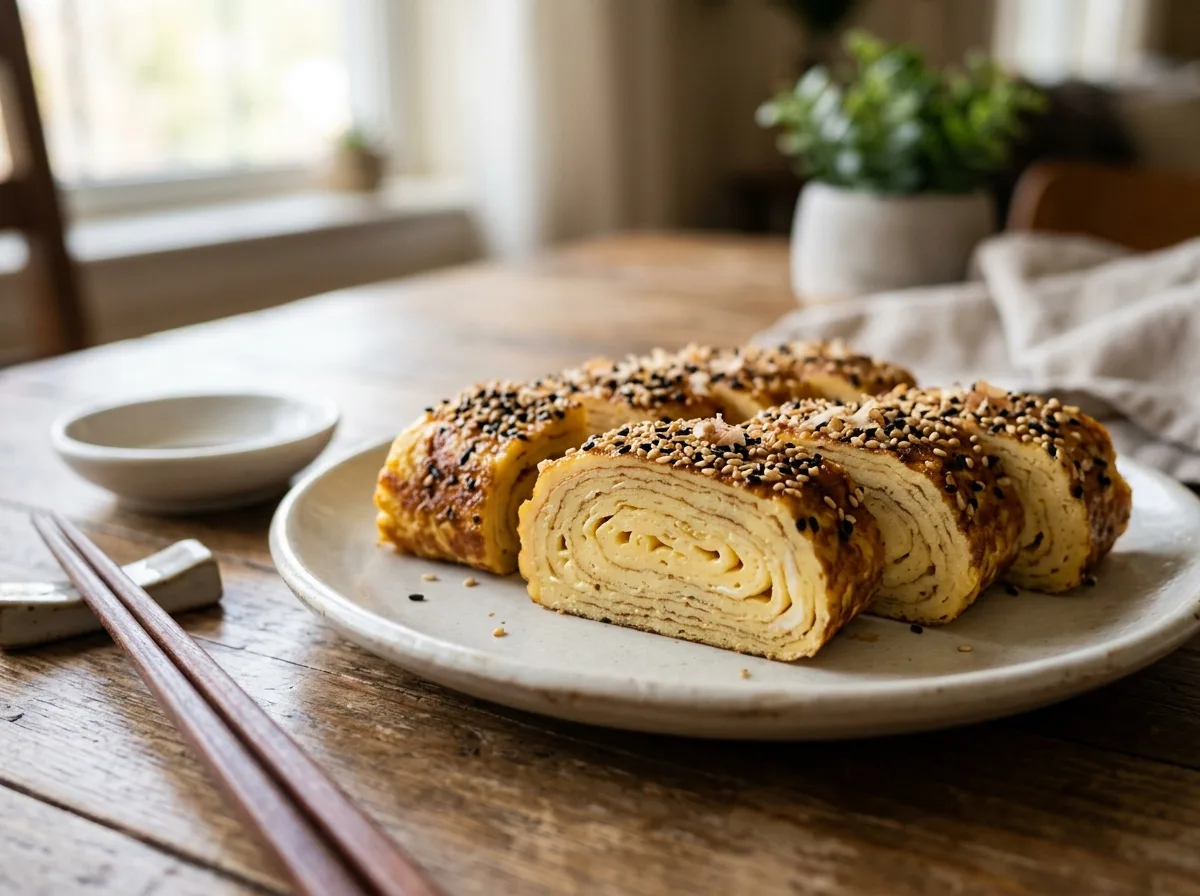
Japanese Tamago-Style Rolled Omelette with Sesame Seeds
Rate this recipe
~$1.20 CAD per serving (estimate)
Ingredients
- 3 largeeggs
- 1 tspsoy sauce
- 1 tspcaster sugar
- 1 tbspwater
- 1 tspghee
- 1 tbspsesame seeds
Nutrition / serving
- Calories160 kcal
- Protein11 g
- Carbs3 g
- Fat11 g
- Fiber0.5 g
Cost Estimate
~$1.20 CAD per serving (estimate)
Tamagoyaki is the rolled omelette you find tucked into Japanese bento boxes — layered, just barely sweet, and far more satisfying than a flat egg. The technique looks intimidating until you do it once: you pour a thin layer, let it set at the edges, roll it toward you, push it back, pour again. A small non-stick pan and a bit of patience are all it takes. Sesame seeds pressed into the outside add a gentle crunch that makes each slice worth looking at.
Instructions
Mix the egg base
Crack the eggs into a bowl and add the soy sauce, sugar, and water. Beat with chopsticks or a fork until completely uniform — you want no streaks of white. Do not whisk vigorously; you are not after foam.
Heat the pan
Set a small non-stick pan (roughly 18–20 cm) over medium-low heat and add the ghee. Tilt the pan to coat the base evenly. The ghee should shimmer but not smoke — if it browns immediately, lower the heat.
Pour the first layer
Pour in about one-third of the egg mixture and tilt the pan so it spreads into a thin, even layer. Let it cook until the edges are just set and the centre is still slightly glossy, about 45–60 seconds.
Roll toward you
Using a spatula or chopsticks, fold the far edge of the egg toward the centre, then roll it the rest of the way toward you so you have a compact log at the front of the pan. Slide it to the far end.
Add the second layer
Pour in another third of the egg mixture, lifting the existing roll so the raw egg flows underneath it. Let this layer set at the edges, then roll the existing log back over it toward you. Repeat with the final third of the egg.
Shape and press seeds
Transfer the finished roll to a small sheet of cling film or a bamboo mat and shape it into a tight cylinder while still warm. Immediately scatter the sesame seeds over the outside and press them gently so they adhere before the surface cools.
Slice and serve
Rest for 2 minutes, then cut into 2 cm rounds with a sharp knife. The cross-section should show distinct pale-yellow layers. Serve immediately.
Freeze & Reheat
Tamagoyaki does not freeze well — the egg layers weep and lose their texture on thawing. Make it fresh; it takes under 15 minutes.
Chef's Cool Facts
Why sugar in eggs?
The small amount of sugar does two things: it raises the Maillard threshold slightly so the egg browns more slowly, giving you more time to roll without scorching, and it adds a mild sweetness that balances the salt in the soy sauce.
Layers, not folds
Each pour of egg bonds to the previous layer as it sets against it — the result is a cross-section of distinct strata rather than a simple fold. Professional tamagoyaki can have eight or more layers; three is the practical home-cook version.
Soy sauce colour
Even a teaspoon of soy sauce tints the egg a warm amber. In high-end Japanese cooking, dashi-seasoned tamagoyaki uses white soy (shiro shoyu) to keep the egg pale yellow — a visual signal of restraint and technique.