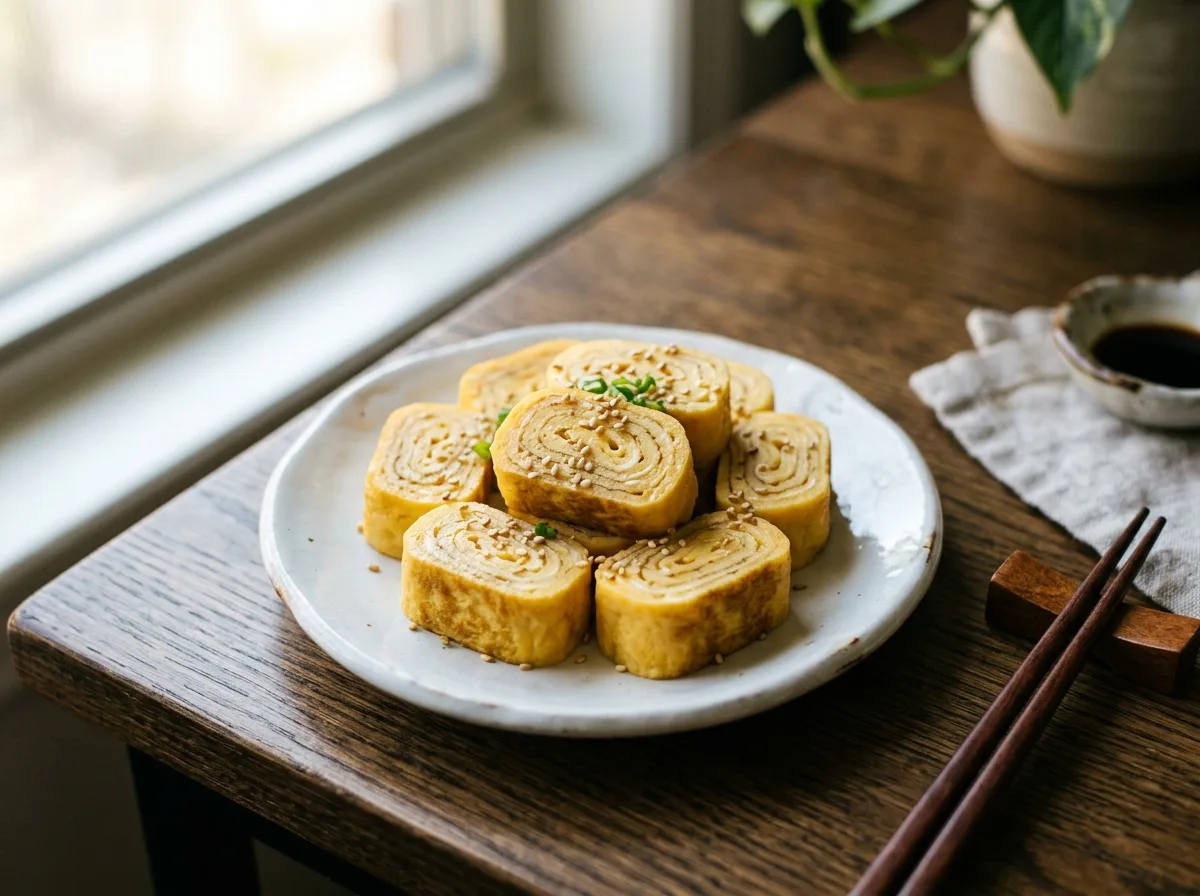
Japanese Tamagoyaki with Sesame Seeds
Rate this recipe
~$1.20 CAD per serving (estimate)
Ingredients
- 3 largeeggs
- 1 tspsoy sauce
- 1 tspsugar
- 1 tbspwater
- 1 tspolive oil
- 1 tspsesame seeds (white or mixed)
Nutrition / serving
- Calories145 kcal
- Protein10 g
- Carbs3 g
- Fat10 g
- Fiber0.2 g
Cost Estimate
~$1.20 CAD per serving (estimate)
Tamagoyaki is a rolled omelette built in three quick passes across a hot pan — each layer just set before the next is poured. The result is a tight, golden log with a custardy interior, sweet-savory from a touch of soy and sugar. It takes about eight minutes once you have the technique, and the sesame seeds pressed on top add a faint nuttiness that makes it feel finished rather than plain. Serve it sliced on a small plate beside steamed rice or miso soup.
Instructions
Beat the egg mixture
Crack the eggs into a bowl and add the soy sauce, sugar, and water. Beat with chopsticks or a fork until fully combined and no streaks of white remain — about 30 seconds. Do not whisk aggressively; you want minimal foam.
Heat the pan
Set a small non-stick skillet or tamagoyaki pan (roughly 18 cm) over medium heat. Add the olive oil and swirl to coat. The pan is ready when a drop of egg mixture sets within two seconds of contact.
Pour the first layer
Pour in one-third of the egg mixture and tilt the pan so it covers the surface in a thin, even sheet. When the edges are just set but the centre is still slightly glossy — about 30 seconds — use a spatula to roll the omelette away from you into a compact log at the far edge of the pan.
Add the second layer
Slide the log back to the near edge. Pour in half the remaining egg mixture, lifting the log so the raw egg flows underneath it. When the new layer is just set at the edges, roll the existing log over it toward the far edge again, incorporating the new layer.
Add the third layer
Repeat with the last of the egg mixture, lifting the log and letting the raw egg run underneath. Roll once more. The finished log should be firm enough to hold its shape but still feel slightly yielding when pressed gently.
Press and rest
Transfer the tamagoyaki to a small sheet of plastic wrap or a bamboo sushi mat. Roll it up firmly and shape it into a neat rectangle. Leave it to rest for 2 minutes — this sets the shape and lets the residual heat finish the interior.
Slice and finish
Unwrap and slice into rounds about 2 cm thick. Arrange on a plate, cut side up, and scatter the sesame seeds over the top. Serve immediately.
Chef's Cool Facts
Why sugar in a savoury egg dish?
The small amount of sugar does more than add sweetness — it raises the Maillard reaction threshold slightly, giving you a little more time before the egg browns, and it contributes to the omelette's characteristic tender, almost silky texture.
Three-layer rolling is structural, not decorative
Each pass of egg bonds to the previous layer while still moist, creating a laminated structure. That layering is what gives tamagoyaki its distinctive cross-section of concentric curves rather than a uniform mass.
Soy sauce as seasoning anchor
A single teaspoon of soy sauce adds sodium and glutamates that deepen the egg's flavour without making the dish taste Japanese in an obvious way. It functions the same way a pinch of salt in a custard does — you notice its absence more than its presence.