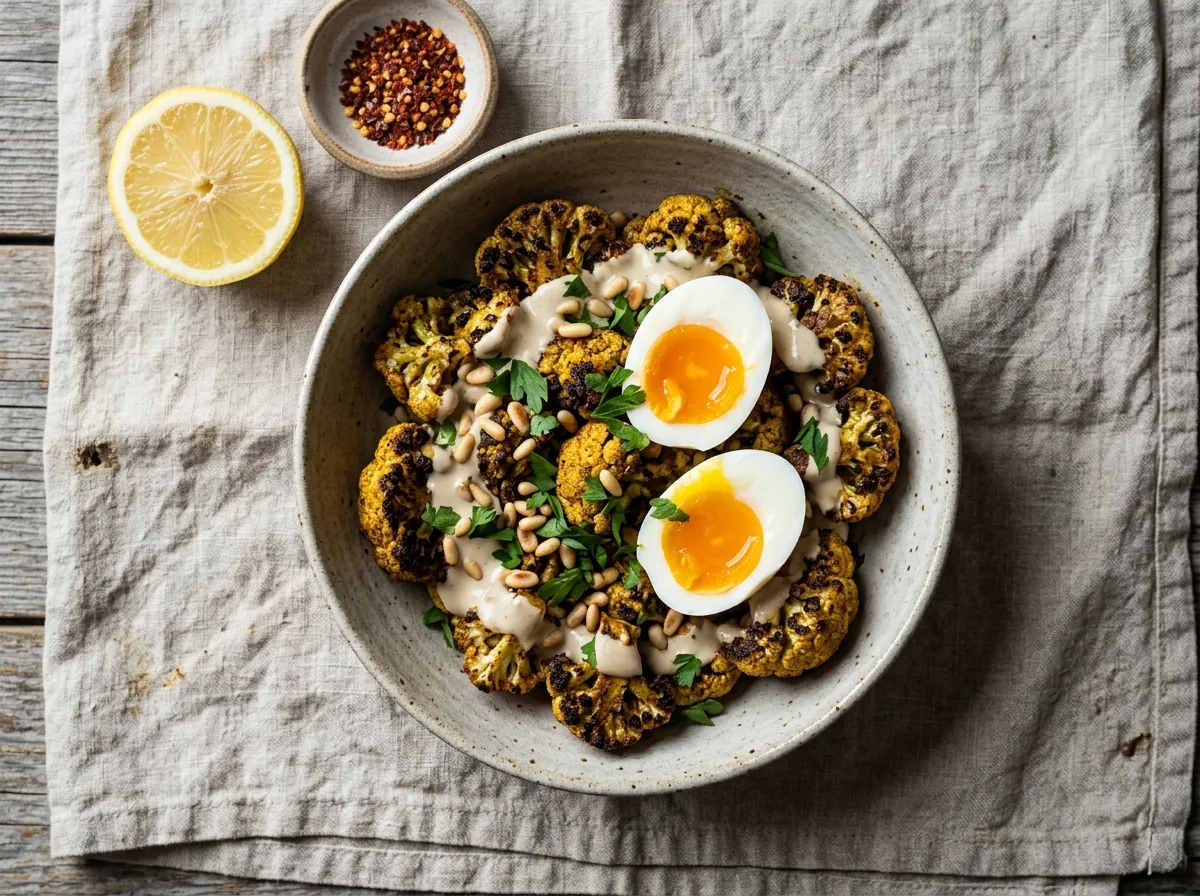
Middle Eastern Spiced Egg and Roasted Cauliflower Bowl
Rate this recipe
~$3.80 CAD per serving (estimate)
Ingredients
- 1 large headcauliflower, cut into 4–5 cm florets (about 800 g florets)
- 3 tbspolive oil
- 1.5 tspground cumin
- 1 tspsmoked paprika
- 0.5 tspground coriander
- 0.5 tspgarlic powder
- 0.75 tspfine sea salt
- 0.25 tspblack pepper, freshly ground
- 8 largeeggs
- 60 mltahini (well-stirred)
- 30 mllemon juice, freshly squeezed (about 1 lemon)
- 1 clovegarlic, minced
- 45 mlcold water (more as needed to thin)
- 30 gpine nuts
- 10 gflat-leaf parsley, roughly chopped
- 0.5 tspAleppo pepper or mild chilli flakes (optional, for finishing)
Nutrition / serving
- Calories390 kcal
- Protein18 g
- Carbs14 g
- Fat30 g
- Fiber5 g
Cost Estimate
~$3.80 CAD per serving (estimate)
High heat is the whole trick here: cauliflower florets roast at 220 °C until the cut faces go deep gold and the edges char, concentrating a sweetness that raw or steamed cauliflower never reaches. Soft-boiled eggs, a tahini-lemon drizzle, and toasted pine nuts land on top, and the bowl comes together in under 35 minutes with almost no active work. It is vegetarian, genuinely low-carb, and filling enough to hold you through the evening.
Instructions
Heat the oven
Place a large rimmed baking sheet in the oven and heat to 220 °C (425 °F) conventional, or 200 °C fan. Preheating the pan is what gives the cauliflower its immediate sear on contact.
Season the cauliflower
Toss the florets in a large bowl with the olive oil, cumin, smoked paprika, coriander, garlic powder, salt, and pepper until every piece is evenly coated. Spread in a single layer on the hot baking sheet — do not crowd; use two sheets if needed.
Roast until charred
Roast for 22–25 minutes, flipping once at the 15-minute mark, until the flat faces are deep golden and the smallest florets have charred edges. The cauliflower should smell nutty, not steamy.
Soft-boil the eggs
While the cauliflower roasts, bring a small saucepan of water to a full boil. Lower the eggs in gently and cook for exactly 7 minutes, then transfer to an ice-water bath for 2 minutes. Peel and halve lengthwise — the yolk should be set at the edges but still jammy in the centre.
Make the tahini drizzle
Whisk together the tahini, lemon juice, minced garlic, and cold water until smooth and pourable — it will seize first, then loosen. Season with a pinch of salt. If it is still too thick, add water a teaspoon at a time.
Toast the pine nuts
In a small dry skillet over medium heat, toast the pine nuts for 2–3 minutes, stirring constantly, until they are golden and fragrant. Pull them off the heat the moment they colour — they burn fast.
Assemble the bowls
Divide the roasted cauliflower among four bowls. Nestle two egg halves into each bowl, drizzle generously with the tahini sauce, and scatter over the pine nuts, parsley, and Aleppo pepper if using. Serve immediately.
Chef's Cool Facts
Why high heat transforms cauliflower
Cauliflower is about 92% water. At 220 °C, that moisture evaporates quickly and the surface temperature climbs high enough for the Maillard reaction to kick in — the same browning chemistry that colours a seared steak. The result is a nutty depth that low-and-slow roasting never achieves.
The tahini seize-and-release
Pure tahini is an oil-in-water emulsion. When you first add lemon juice or water, the proteins tighten and the paste clumps — this is normal. Keep whisking and adding water slowly; the emulsion re-forms and turns silky. Adding garlic early helps stabilize it.
Seven-minute eggs
At the 7-minute mark in boiling water, the white is fully set and the yolk has gelled at its outer layer while the core stays soft. One minute less gives a runny centre; one minute more pushes it toward fully hard-boiled. The ice bath stops carryover cooking the instant the eggs leave the pot.
Pine nuts and the Middle East
Stone pine trees (Pinus pinea) have been cultivated around the Mediterranean and Levant for at least 6,000 years. In Lebanese and Syrian cooking, pine nuts are almost always toasted in a dry pan or in ghee before use — the dry heat drives off residual moisture and concentrates the resinous, buttery flavour that makes them worth the price.